4/12
One of the themes of this book, however, is that it’s not enough to have some nice, ego-inflating ideas in your head; your “positioning” only really exists insofar as it exists in the minds of the people in the market you’re targeting.
It may be that, as a solo consultant, this “positioning” only exists in my dreams, but at the very least I want to prove to you, dear reader, that I walk the talk. I believe you and your startup need to eventually transcend your category and create a super position in your market, and as a humble consultant, I’ve tried to do the same in my market, transcending the existing approaches by creating a new default way of seeing the world. (Even if it’s only when I close my eyes.)
Jump around and just read the parts that are relevant to you. Pick a strategy or two to explore, jump back to the exercises and your narrative, whatever makes sense for your stage and situation.
10/11
This wasn’t just at the tiny startup end of the spectrum, either. I saw up close the kind of advice a company I’ll call The Unicorn was receiving. ($200M+ raised buys you a lot of advice.) It wasn’t great. I was a little taken aback. Was this really the best we could do as an industry?
I shipped one mammoth textbook-length book (Positioning Playbook), immediately realized no one wanted to read that, tried to summarize it into a new book, got over my skis, hit a wall, did some more client work, and gave myself enough time to finally try and solve my own positioning problem. How do I find one big idea that I can put on folks’ radar that captures all the important pieces I want to bring together in a new, coherent whole?
The problem I found, however, was that everyone was focused on their tool, not the toolbox, as I touched on last chapter, and everyone seemed to contradict each other. Do you go big, or do you go narrow? Do you start with your competitors, or do you ignore them entirely? Does brand matter, or is it irrelevant? (And if it matters, what does it even mean?)
But you tell me what works! I’m only ever an email away: [email protected]. Send me your finished narrative — I’d love to see it!
Creating a strategic narrative
There’s a lot of juicy stuff to come in terms of super positioning as a framework, but ultimately the point of this book is to help you capture your positioning choices in a simple, high-level pitch: a story for the market with 10-or-so slides that clearly articulates:
- What’s changed?
- What do I do?
- What’s the resulting new world?
That’s your strategic narrative. The change might be as broad as the AI revolution sweeping the world or as niche as the specific tool you’ve built for a specific role in a specific industry. The resulting new world is the value only you can deliver in a tangible business and personal sense for the buyer.
And at the heart of your narrative is a simple idea or hook that powers just about everything you do — an idea that’s bigger than your product.
Or, as Gall’s law says (my bold):
A complex system that works is invariably found to have evolved from a simple system that worked. A complex system designed from scratch never works and cannot be patched up to make it work. You have to start over with a working simple system.
This is a book about finding that working simple system.
But simple ain’t easy, and good lord, no one knows that more than your humble author. Prior to writing this book, I put every idea I had regarding neuroscience-based positioning into my textbook-length Positioning Playbook for B2B SaaS.
It was dense but it sure wasn’t simple. (If you’re a hardcore positioning nerd, though, check it out!) So I started over and built this simple system — super positioning — instead.
5ws
As a system, super positioning explains where narrative (yes, even including category creation!), competitive positioning, and modern brand theory all fit. It’s more than a spreadsheet or a wish that won’t come true, it’s a meta framework for knowing which approach to use, when, and why.
Why listen to me?
! I’m very much standing on the shoulders of giants in terms of the specialists we will draw from throughout this book, and I’m extremely grateful for all their wisdom and expertise that they’ve shared over the years. This book wouldn’t exist without it.
Building a super position
This book exists because venture-backed startup positioning is different and it’s hard.
Why? Venture-backed startups are not normal businesses.
They need to do two very different things at the same time: find an efficient place to start and maintain an expansive vision for what could be.
Startups are about big swings and big ideas; customers just want what helps them today.
How do we square that circle?
Typical marketing positioning focuses on the latter — what helps customers today — and it’s inherently focused on efficiency. It’s usually done by marketers who are trying to find (or add a bit more clarity to) what’s already working, and not get fired for suggesting anything too radical. That’s great for finding an efficient place to start or maintain an efficient GTM motion, but it’s incomplete in terms of capturing the big ideas washing over your customers’ world, especially in the AI age.
Startups aren’t about efficiency, they’re about risk. The risk is the point — you get funded precisely because you take big risks for big outcomes.
This requires a different approach to positioning — you’re not looking to just refine an existing position that’s already been established in the market. You’re playing to win. You need to build a super position that transcends your existing category entirely.
In the past, some folks labeled this “creating a category,” though the term is less popular these days.
Category creation was right in the directional sense — startups really do need to think big on a category level — but on a practical level, the focus on the category was fundamentally flawed.
In any case, there are already more than 2,000 B2B categories on G2 alone, and while category creation does still happen (see the rise of AI-first categories), competition is so intense that no single player is going to be left alone to “create” a category and no startup has time to invest in evangelizing a category name before evangelizing their product.
In today’s market, that’s suicide.
The stakes today are higher
Today in startup land, the stakes are higher for individual startups because competition is that much more intense.
Positioning exists because competition exists, and as the competition in your market gets more intense, your approach to positioning — and your strategic narrative — needs to get more intense, too. Today, you need to be that much more deliberate about how exactly you compete, how exactly you’re unique, and how exactly you’ll build a (super) position in the market.
Those are three powerful levers you can pull to help unlock your next stage of growth and ultimately build a category-transcending super position in your market.
How they won isn’t how you’ll win
If you’ve founded, invested in, or work for a startup, you know all too well that it’s not enough to carve out a nice little efficient niche business.
“Strategy” is just another way of saying “make deliberate choices,” and this book is very much about helping you think through the deliberate choices you face and building a super position that’s unique to you.
If you have to win, then it makes sense to learn from how others have won, too, and in this book we’re going to explore plenty of examples of winning startups.
But if different startups win in different ways,
(“Here’s everything that’s ever worked for anyone,” which describes much of the ’80s and ’90s writing on positioning)
When all you’ve got is a hammer…
However, because startups are about winning, everyone is very keen to tell founders how they (or some startup they’re fond of) won.
Being able to pick the right tool for the job is pretty obvious, right? So why hasn’t anyone done that? What’s missing?
The neuroscience of positioning
The problem is that, until now, we’ve lacked true positioning fundamentals that explain why specific approaches or tactics work, and why they might not.
Without any science to inform what we’re doing, we’re left with anecdotes — this worked for me, maybe it’ll work for you, too?
Maybe!
It is valuable to know what has worked for folks in the past. But it’s even more valuable to have a theory that explains why those approaches worked — and didn’t work — because then we can use them strategically. “Strategy” is just a fancy word for deliberate choices, and that’s what this book is about — showing you how positioning and pitching startups work using some very simple neuroscience so you can make deliberate choices about how you go about positioning and pitching yours.
29/10
char test
➡️⬇️🔁 ↺⟲⥀↻⬅︎←→➡︎↓⬇︎
↺⟲⥀↻⬅︎←→➡︎↓⬇︎
In text example, our three prongs (→↓↺), and more
In text example, our three prongs (→↓⟲), and more
In text example, our three prongs (→ ↓ ⟲), and more
In a list example:
- → Narrative
- ↺ Brand
- ↺ Brand bold:
23/10
5ws
Don’t get me wrong — I love my fellow marketers. I assume most people reading this are marketers. And I know they’re often the ones most frustrated by how little strategic leverage they seem to have.
My suggestion is to follow the same path I’ve found helpful and try to bring everything back to the position you’re building in the mind of the buyer. On the GTM side, doing that effectively is just about all that matters.
Nevertheless, I think we can agree that a winning positioning strategy is unlikely to be something you stumble across at the bottom of a spreadsheet. (Or in the delusions of famous pop-business books, for that matter.)
20/10
Typical marketing positioning is about finding some point of difference, or some angle for your band, so that you can stay competitive in an otherwise mature market. You’re a bit more this, they’re a bit more that, but otherwise everyone is much the same.
Most founders & GTM leaders — or the ones I like working with, anyway — devote most of their attention to their product first and company second, thinking hard about the next feature, the next deal, and the next raise.
That’s important — the product comes first! — but what’s often neglected is the market half of product/market fit, and the idea that’s bigger than your product that you’re bringing to that market. That’s exactly what I hope this book helps you with.
After all, B2B buyers aren’t buying software for its own sake, they’re buying it to adapt to a change in the world, or for a particular outcome your innovation enables. The better you capture that as a driver to your product as a narrative you can seed in the market, and as a brand takeaway people remember from your product and GTM efforts, the much stronger your positioning will be.
…int he past, take category idea, now, it might be AI as a concept,
Take the AI wave, for example. There’s a rush of early adopters who have literally been told to buy and try new software because an external change — the rise of AI — demands it.
… todo repeat
… spirtual successor to category creation
….Super positioning, as a framework, sits above — and incorporates the best insights from — traditional approaches to positioning, while giving you the flexibility to match the right approach to your audience.
18/10
Big swings require big ideas, and that’s what we’re going to explore, with a particular focus on capturing your own big ideas in a strategic narrative, which I’ll be walking you through step-by-step.
===
If we want to understand and unlock a market for your product, we need to take a first-principles approach to understanding how markets work.
It also acknowledges that founders and GTM leaders in venture-backed startups need to do positioning in a fundamentally different to typical product marketing in tech.
If that’s you, you need to transcend your category, not create yet another one.
You are the new, disruptive force carving out a winning position in a new market or a healthy slice of an existing one. You are, by definition, the underdog. For people to buy your product, they have to know, understand, and choose your product. That is, they have to have a winning position for your product in their mind.
Success or failure in the market hinges on that reality.
Building — and finding — that unique position is what this book is all about, especially in a first-principles sense.
17/10 brand
From niche to brand reach
The key specific here is knowing whether you’re trying to find product/market fit in a niche, or if you’ve found it and it’s time to branch out and reach more customers.
That, and the fact that “brand” tends to mean a million different things to a million different people.
If you’re going to tie down a definition of “brand” in a workshop, make sure you’re very clear about brand purely as memory association, or you can look forward to a lot of pointless chat about logos, colors, or that cool website company X just released that everyone will forget about next week.
The point isn’t the symbols you use — anything competent is fine — it’s the connections you make. Those connections take time, and you can only spend that time once.
15/10
strat nav
What we’ll look at here leans more to the sales end — B2B is often a sales-driven world, after all — but as always, keep in mind the attention preferences at play.
Putting together a story 1-driven strategic narrative can be extremely useful internally (both for your own leadership and for investors), but the extent the whole narrative will work in a sales context depends on the mode of attention of your audience.
It was “strategic” in that it captured a change that leadership had to respond to — the so-called subscription economy required a new approach from enterprise companies and Zuora, naturally, had the solution.
This approach to the strategic narrative has since been pigeonholed as “just for investors,” but that’s not true — it was specifically a high-level sales deck derived from the enterprise world. That was the job it had to do. (The reason it also worked with investors is because those folks use the same mode of attention.)
Even in the Snowflake example, there’s still something they’re putting on folks’ radar — managed, fast, and deep (in terms of storage), in their case.
The recurring theme, however, is still figuring out what your unique concept is that you can put on folks’ right-brain radars.
Startups and R/L/R
As an aside, it’s highly likely this R/L/R process reflects the typical startup journey itself, especially at the early stage. The founder has a vision about something ‘out there’ (R), then gets into the weeds for a couple of years focused down on building product, working with customers, and seeing what resonates (L), and then emerges with a new, integrated whole — the polished, innovative tool (or book, for the wordcels) with a dialed-in narrative to match (R).
It’s another one of those profound ideas from McGilchrist that explains so much!
What we’re really trying to uncover here is a catchy way to describe the value you propose, or your ‘value proposition’ in marketing speak.
The reason we started with a hook test in chapter 3 was because the best pitches — and the best value propositions — spread. They get caught and passed on. They’re memetic. They stick. They get repeated and reused. And they’re great for owning an association in the buyer’s mind.
To do that, they have to be catchy. They have to capture a big idea in a precious few words. And if you can do that a few times, you create a rich narrative universe that resonates as true because you’ve adeptly described a bunch of things people have always had a sense of but never truly put their finger on. (Compare that to a stark buzzword that everyone instantly rolls their eyes at.)
- Slide 1: Intro (or Meet [Product])
- Lead with a catchy take on your micro-pitch.
- Remember BLUF — bottom line up front. What category do you operate in? What’s the value you’re proposing?
- Slide 2: Macro trends/pains
- Context setting — the wave, change, shift, or new reality for story 1 pitches.
- The specific pains you’ve pinpointed for story 2 pitches.
- Slide 3: The need
- How does your context-setting or insight relate to the prospect?
- What’s the tension you’re working with?
- How do you outline the need in 3 bullets?
- Slide 4: The challenge
- Discuss why and how the prospect in particular struggles with this tension.
- Describe and agitate their pain in a way that should have them nodding along.
- Slide 5: The status quo
- They understand the change, pains, and need, and now we want to explain why typical solutions don’t work.
- Hit the options people typically try but are flawed because they’re too hot/too cold. You’re setting up your Goldilocks solution (just right).
- Slide 6: The opportunity
- Tease a new way (or a ‘promised land’) where the prospect is winning and/or the pain is solved.
- Slide 7: The product
- The big reveal of the hand-in-glove obvious solution to the problem you’ve outlined.
- Slide 8: The product pillars
- Join the dots for the prospect, connecting core features to value. (We’re into story 2 mode here, or the middle L in R/L/R.)
- Slide 9: The impact
- Outline what this means for…
- The end users.
- The team and managers.
- The executives or broader company, resolving the tension of the problems you set up earlier.
- Slide 10: The result or outcome
- The new integrated whole with your product at the center. (The final R in R/L/R.)
- Slides 11 and beyond:
- More on the product, proof, and next steps — always suggest next steps — the pilot, the trial, the next call, etc.
In super positioning, the point isn’t the change per se that drives the narrative (though it can be!) it’s the concept that’s bigger than your product. That might be a change, but it might be your innovation (especially in the AI era), it might be your category concept, it might be your playbook — it’s whatever you need to put on folks’ radar that changes their context, changes their behavior, and ultimately changes their purchase decision so they pick you.
25/9
The best and hardest thing about positioning is that it forces you to be specific.
Being specific creates a hook, and hooks are what get lodged in the mind of the buyer.
This means being specific about your positioning strategy, not just your words.
Marketers get confused by this all the time. They see big brands using broad language and think “Aha! They don’t get it! Their broad headline is meaningless!” Sometimes, that’s true. But big brands are specific about what they’re trying to do: reach as many people as possible. They’re not trying to find a niche. They’re not trying to start up. They’re well beyond that. And that’s a legitimate and specific positioning strategy!
Startups, on the other hand, don’t have that luxury. They need to break into the market, and usually that requires being very specific about something.
(Unless you’re Rippling, that is, and you’re building a multi-product compounding startup, zigging where everyone else is zagging with a unique strategy.)
In this chapter, I’m going to give you a crash course on specifics in a way that both summarizes the book and gets you thinking about your positioning.
Consider this a mini-workshop you can do either solo or with your team to tease out your “strategic specifics.”
Running a workshop
I refer to the next three chapters as mini-workshops because they’re hands-on. They’re designed to help you take the ideas from this book and turn them into concrete reality by following some loose steps.
You can do this solo as a thought experiment or you can do it with your team in a very concrete way. My hope is that this helps you:
- Flesh out the strategic specifics of your existing positioning and identify where the gaps are.
- Develop consensus with a focus on a short sales narrative.
- Audit and update your customer-facing messaging.
That’s a significant amount of work!
I’m going to imagine you’re doing this solo, with me asking the questions to get you thinking. However, if you’re quarterbacking a more substantial positioning project with your team, you can play my role and do the question asking instead.
If you are doing this with your team — and positioning is team sport, so I highly recommend you try it — it’s worth creating a bit more structure in your workshops which I won’t be covering here. The good news is, however, that Google, ChatGPT, or your LLM of choice will have plenty of tips on running effective workshops, and you can make the final workshop process as formal or informal as you like. (Feel free to feed your AI this chapter and your context and get it to spit out a workshop format that’s right for you!)
A word of caution though: Positioning is serious business, so if you’re bringing your leadership together, try and be clear about (a) the diagnosis that indicates you have a positioning problem, and whether there’s alignment around that, (b) how much scope actually exists for iterating on your positioning, i.e. how much risk they’re prepared to take, and (c) what sort of investment and timeframe you’re looking at.
As the old saying goes, the gap between reality and expectation is disappointment, so make sure you calibrate everyone’s expectations accordingly. Positioning can be an incredibly powerful lever at your disposal, but creating an actual position in the mind of the buyer can be a months-to-years long process, so prepare accordingly. It’s not about tweaking the homepage and thinking that nuance will suddenly be beamed into thousands of buyers’ minds.
In any case, for our purposes here, grab a pen and paper and get ready to answer some questions as specifically as you can!
Being specific
Specificity (try saying that five times fast) is the name of the game here, but specific about what? And in what way?
There are specifics about your product or company that might be unique or interesting to you, but have no broader strategic implications as far as customers are concerned. Think: the programming language you used. The obscure feature or integration you built for that one customer. Even things like your mission, culture, or values might be unique, interesting, and specific to you, but they’re probably not reasons for customers to buy you.
Instead, we’re interested in strategic specifics.
Those specifics are, like just everything in this book, products of the three prongs of super positioning, which are:
- ➡️ Narrative: A change in the world you’ve identified, like HubSpot and “inbound marketing.”
- ⬇️ Positioning: A unique insight you’ve found, perhaps in the weird way customers used your early product, like Loom and short video sharing.
- 🔁 Brand: A memory association you can build in the market place, like Squarespace advertising on every podcast, ever, so when we hear “Squarespace” we think “websites.”
They’re a good start, but we want to build your positioning around your most powerful ideas. This isn’t a tick-box exercise.
So instead, I want you to think about what makes your product or startup:
- Insanely relevant.
- Insanely useful.
- Insanely memorable.
Powerful ideas drive powerful positioning, and I’ll ask you a bunch of questions to flesh out your powerful ideas below. If you get stuck or don’t think your current ideas are very powerful, that’s totally normal. That’s why the strategy chapters exist — to help you identify and build these powerful ideas into your positioning.
But what makes a positioning idea powerful? What kind of information makes people take action?
Specifics.
There’s a murder on the loose!
Specifics create relevance. If the specifics are relevant to me, I care. If they’re not, I don’t.
Consider this not-entirely-serious example:
- “There’s a bad person in your city.” Ok, who cares?
- “There’s a murderer on the loose in your neighborhood.” Ok, now I’m a bit scared!
Both these phrases describe the same thing. The latter, however, obviously does a better job of describing both the magnitude and proximity of the issue. The closer and more specific the danger becomes, the more I’m likely to take action!
This is a silly example, but it’s just meant to make a simple point: specifics determine relevance, and relevance determines action. Things that are relevant to us are things that feel close to us. The more something is close to us — our location, our needs, our context, our physical safety (!) — are more we’re inclined to act on it.
Rather than a feeling of danger being close by, we’re obviously trying to create a feeling of value that’s close at hand. And it is a feeling. We want our buyers to feel like it’s a no-brainer to reach out and grab the value we’re putting as close to them as possible.
Therefore (if you’ll forgive the LinkedIn-worthy segue), in startups, the art of positioning is to take a product or idea and make it as specific and close to some group of people who will pay money for it.
That group of people could be very small or very large; it’s not about the size of the market. It’s simply about being the ‘close’ option in their mind.
Three steps to strategic specifics
Let’s run through our super positioning prongs (➡️ ⬇️ 🔁) and see what strategic specifics emerge. These are the positioning tools we ultimately use to help you get known, chosen, and remembered.
1. Narrative specifics ➡️ — what’s insanely relevant?
What strategic specifics do you have that could work on the right-brain radar of narrative and change stories?
To be insanely relevant, you usually have to tap into a change that’s happening in the world, one that’s independent of you and your company. (That’s why ‘ride it’ — riding a wave — is the corresponding strategy here.)
Let’s think about what is or could be insanely relevant for your customers in terms of technology, tools, and transformation.
Technology
- What’s insanely relevant in terms of fundamental technology that’s washing over your customers and their industry? (AI, obvs, but in what way?)
- How do you specifically bring this general technology closer to their actual needs?
- What insanely relevant second order effects are occurring due to this technology? (E.g. It’s now possible to automate X; or an old category like voice recognition or note-taking is new again.)
- Or, have you created new general technology that you’re putting in customers hands for the first time? (E.g., you’re a new AI lab.) What is it? How do you describe it? What makes it so relevant?
Tools
- Have you created a new tool or product that’s insanely relevant for a specific set of customers? (E.g., Superhuman for people who live in email.)
- Have you innovated on the application layer to get closer to how your customers actually work — and perhaps closer to their expectations for modern software, too? (E.g., Linear vs. Jira.)
- Is there some specific outcome you’ve proven your customers achieve with your tool thanks to some specific capability that’s unique to you? (Think highly specific results in very niche industries. E.g. you’re the only solution for some obscure manufacturing process, or a unique solution in some highly regulated industry.)
Transformation
- Is there an insanely relevant transformation that’s sweeping an industry? That could be regulatory changes, new ways of working (agile, back in the day), new technology-driven social behavior (social networking in the ’00s, messaging in the ’10s, creators in the ’20s), changes in the competitive environment, and so on.
- Or, do you have a vision for your industry you think is insanely relevant? (It’s a high bar for a reason!) We’re all in the digital transformation business, but what does that look like in your industry, in whatever wave of change you find yourself? (“Businesses should build their own tools,” per Notion, for example.)
- Can you name an insanely relevant new from/to transformation? The old way is _____, the new way is _____. (“Inbound marketing” replacing “interruptive marketing,” for example)
- Is there an emerging role your product serves you can get close to and champion? (“Design systems manager,” “Customer success,” “GTM engineering,” etc.)
- Are you trying to ‘create a category’? (It’s ok, I won’t bite!) Do you have a new concept or playbook about how work is done in the AI age (for example) that you can put in your customer’s hands? (“Experience management” in Qualtrics’ case.)
Your answers here form the basis of what I call your ‘story 1’ change story. (The two modes of attention — broad right-brain and narrow left-brain — mean there’s two broad types of stories we’re working with.)
Maybe your tool is the change, but more likely it’s something sweeping your customer’s industry that’s much bigger than you.
We’ll explore the specifics of what that these change stories can look like in the coming chapters, but for now we can think about these narrative strategic specifics as the drivers of your positioning.
The x-axis of positioning
These are the bigger themes you might talk about on social media, on podcasts, in conference talks, and so on, to drive interest in your product and drive people to your website.
This is the x-axis of communication that’s fundamentally about what you’re putting on folks’ radar. This is the initial creative act that’s driven by your vision — the wave you saw, the product (or playbook) you built, and the initial value you proposed.
(And if you need more inspiration, jump to the ‘ride it’ strategy chapter!)
Your turn
- Which approach above — tech, tool, or transformation — best matches what you’re currently doing?
- Write down your ‘strategic specifics’ for this section.
- Give it a specificity score of 1-5. A score of 1 is “just a vague thought” and 5 is “customer validated and killing it in the marketplace.”
- How do you rate your story 1 specifics?
- How would you improve this part of your positioning? What’s missing? What needs clarifying?
2. Positioning specifics ⬇️ — what’s insanely useful?
In super positioning, we put something on folks’ radar (➡️) then they switch modes of attention to analyze the competitive alternatives (⬇️).
For example, I might hear that AI makes it possible to summerize meeting notes. Maybe I hear that through some piece of marketing or social media chatter, or maybe it’s just that all my colleagues are using AI meeting note takers. They might give recommendations but I want to make up my own mind.
Therefore, I’m going to go from broad ‘radar’ awareness to a narrow-focus comparison of alternatives.
From the startup’s point of view, this means you’ve successfully set the context for why they should choose something, but now it’s time to dive down into why should they choose you. And the main reason people will choose you (beyond price) is that you appear to be insanely useful to them.
You need to be insanely useful to overcome the ‘pain of change.’ For people to switch tools, to use the old Tony Robbins quote, the pain of staying the same has to be greater than the pain of change. And that pain is driven by the insane usefulness they would otherwise be missing out on.
This is where we get narrow and focus on what’s different relative to competitive alternatives. Not just peer competitors, either, but how they’re currently solving this ‘job to be done’ (manual processes, spreadsheets, outdated tools, etc).
First, let’s get specific about about the basics:
- Who — customers: Who are the people you’re targeting? Why? What did you see that made you choose them? What industry, role, or community are you focused on? What segmentation have you done?
- When — triggers: What happens in you customer’s life that triggers them to consider your product? In B2C these are called “Category Entry Points” (CEP), i.e. triggers that cause a buyer to ’enter’ your category. In B2B they might be buying signals like changing role, growing the team, tackling compliance, or some other business necessity.
- How — alternatives: How do your customers currently complete a given job-to-be-done? What alternatives do they use? What do they compare your solution to?
- Why — difference: If they adopt your technology, tool, or transformation, why do they choose you? What’s the magnitude in outcomes relative to the current way that drives their choice?
That magnitude of outcome is the key — you can have all the big ideas about change in the world and do all the zeroing in on a certain customer, but at the end of the day, the juice has to be worth the squeeze. Your product has to be insanely useful to the user and business as a customer.
So what’s the juice for your specific customer?
If you can nail that, you can come away with some very clear messaging along the lines of:
“[Person in role], replace [alternative] and achieve [magnitude of outcome] in [job-to-be-done].”
Maybe that’s transactional lawyers replacing manual processes with your new AI-powered legal tech SaaS that helps them draft and review contracts up to 10x faster. (That example is inspired by Spellbook as we’ll explore further in our ‘ride it’ chapter.)
That’s both very specific and insanely useful! In our ‘find it’ strategy chapter we’ll look at how you can develop this very specific kind of positioning, especially in terms of finding the right ICP for your product.
This is your ‘story 2’ competitive positioning story that matches the analytical narrow-focus attention of customers figuring out why they should choose you.
How you get to that level of strategic specificity can vary, for example, you might focus on:
- Wedge: You’re focused on a very specific wedge opportunity in the market — being ultra niche about a specific role, a specific task, or even a specific price point to create that insane usefulness (or accessibility).
- Attribute: You might go all-in on a specific attribute (collaboration, automation, intelligence, etc.) that you think drives insane usefulness for your ICP.
- Proximity: You might just be better at getting closer to the customer, both in terms of understanding their jobs-to-be-done, what they value, or how they buy, and messaging that back to them. You’re the insanely useful glove that fits perfectly.
- Weirdness: You may have spotted a ‘user innovator’ doing something weird — and very interesting — with your product. A surprising amount of startup success is found in zeroing in on the specific — and insanely useful — thing some customers do with your product, which may not what you’d thought they’d do!
The y-axis of positioning
This is the y-axis of comparative difference. In the world of B2B positioning, rather than trying to guess what might be insanely useful, these strategic specifics are often found by looking down at who is already getting insane value out of your tool or platform and then doubling down on them.
Note that we’ve shifted from the strategic specifics of your x-axis outward vision (the opportunity and the initial product) to your y-axis customer vision — analyzing who’s choosing you, why, and what outcomes they’re achieving. This is the same two modes of attention at play — looking out ➡️ and looking down ⬇️ — as those we’re trying to target.
Your turn
- Who finds you insanely useful? Do you have an ‘ideal customer profile’ (ICP)? Is that speculation (you’re still exploring your market) or validated by studying your customer base (you’ve found a segment to exploit)?
- What job-to-be-done do they choose you for?
- What are the common alternatives?
- What triggers them to enter your category?
- Write down a classic positioning statement along the lines of “We’re an [category] for [ICP], who choose use for [job-to-be-done] because unlike with [alternatives] they achieve [outcome].”
- Give it a specificity score of 1-5. Again, think of a score of 1 as “vague and hand-wavy” and 5 is “proven and validated through detailed analysis and customer contact.”
- How do you rate your story 2 specifics?
- How would you improve this part of your positioning?
(Note that positioning statements are usually pretty lame because they describe usually poor positioning as it is; they don’t help you find a better position. But here they’re useful as a diagnostic tool to see just how specific you can get!)
3. Brand specifics 🔁 — what’s insanely memorable?
Brand is the red-headed step child of B2B marketing, but it’s the universal destination of all marketing and all positioning work, because it’s fundamentally about the memory association you build in the mind of the buyer and market at large.
Therefore, if the first two steps were “what’s new & relevant” ➡️ and “what’s different & useful” ⬇️ this is about “what’s memorable” 🔁.
You might think, “Isn’t what’s remembered what we’ve already talked about, like the big change or our specific differentiation or usefulness?”
That’s true to a point — HubSpot was famous in part for its “inbound marketing” concept. Gainsight was famous for growing the Customer Success category.
But here we’re talking about a very low-resolution takeaway. Hear Squarespace, think websites. Hear ChatGPT, think AI. Hear Figma, think design.
Very few companies can own an association with their entire category, but startup success ultimately demands some kind of memory association between your product and the need you serve. Therefore, it pays to think about how you’ll be insanely memorable.
When the market knows you and remembers you, everything gets easier. You become the first solution that pops into someone’s mind before they search Google or ask ChatGPT. The familiarity you’ve created makes your marketing and outbound sales vastly more effective when you reach out. And other people will happily recommend you, even if they’ve never used you. They just know that if you need a website, maybe you should try Squarespace. (Or Webflow, if you’re in SaaS.)
That’s the power of brand. It’s vastly more than your logo or any of the ‘high-res’ specifics you associate with it, it’s about that insanely memorable hook that’s buried in your memory as a name/need association. Hear X, think Y.
From niche to brand reach
The unspoken specific of finding your brand hook is knowing whether you’re trying to find product/market fit in a niche, or if you’ve found it and it’s time to branch out and reach more customers.
That, and the fact that “brand” tends to mean a million different things to a million different people.
If you’re going to tie down a definition of “brand” in a workshop, make sure you’re very clear about brand purely as memory association, or you can look forward to a lot of pointless chat about logos, colors, or that cool website company X just released that everyone will forget about next week.
The point isn’t the symbols you use — anything competent is fine — it’s the connections you make. Those connections take time, and you can only spend that time once.
Specific sequences
Being insanely memorable in that sense matters, but the big question is, again, for whom?
In product marketing in particular, we’re so used to being specific on the focused, story 2, competitive positioning side ⬇️ that we can forget that, ultimately, building a brand is about switching from niche to reach. Reach means selling more stuff to more people, which is how you grow.
Founders sometimes intuitively know that’s what they want to do, and this tension emerges between founders pulling towards reach and GTM folks pulling towards niche, at least to get started.
I’ve seen this first hand where the founder was trying to fire up the team about conquering the market, while their CRO was trying to very politely but very pointedly suggest they focus on a single niche first. They weren’t on the same page in terms of their strategic specifics for their stage in the market.
To get back on the same page, you need to get folks agreeing on the sequence you want to take. Everyone wants the big outcome — the question is how you get there. The classic positioning advice about getting narrow, finding a niche, focusing just on your best buyers can be great to get started. However, if you are in fact post-product/market fit, then finding a niche becomes less relevant — and maybe even detrimental! — as you should be expanding your brand reach and building those memory connections at scale.
Again, you need to know which game you’re playing.
Reach where, specifically?
Being specific about brand and reach means being specific about where you’re trying to expand your reach. You might reach up or down market, reach into adjacent niches, or or just flat out reach more people using B2C-style brand marketing. Either way, it’s worth being strategically specific about that, too!
For more on owning associated value with your brand, check out the ‘own it’ chapter, or press ahead and we’ll work out your strategic specifics score.
Your turn
- What’s the insanely memorable name/need association you’re building in your marketplace?
- How memorable are the specifics in your story 1 or story 2 pitch?
- When people hear [your brand], they’ll think… what? What’s the association?
- Write down the most focused version of your brand hook — what would it say?
- Write down the most expansive version of your brand hook that you aspire to — what would that be?
- Now, write down where you currently sit on the niche-to-reach spectrum. Are you trying to get a foothold to get started, or are you trying to expand your reach?
- What’s the next move on building your brand? Is it getting more niche to build more momentum, or is it expanding your reach outwards using the momentum you’ve built?
- Give your brand positioning strategy a specificity score of 1-5. A score of 1 is “we’re dreaming” and 5 is “random people associate our brand with our chosen need.”
- How would you improve this part of your positioning?
Your strategic specifics score
Let’s recap. Write down your:
- Narrative strategic specifics — what makes you insanely relevant — and score (1-5).
- Positioning strategic specifics — what makes you insanely useful — and score (1-5).
- Brand strategic specifics — what makes you insanely memorable — and score (1-5).
Now tally up your scores.
If you scored 15 in total — awesome! You are very strategically specific and you’ve got lot of great ingredients for your narrative, which we’ll look at next.
If you scored 10 in total (give or take), you’ve got some serious strengths to work with! You can consider how you can double down on them, or complement them with one of the prongs where you’re weak.
If you scored 5 or less, don’t worry, you’re just getting started! You’re in the right place — everything in this book is designed to help you get as specific as possible about each positioning prong.
Your positioning personality
Your strategics specifics score is just a fun way of positioning your own positioning in your mind, if I can put it that way, by quantifying where you are and where you need to be.
Here’s another exercise that can be fun to think about and useful to discuss, too.
If we put vision and validation on separate axes, and add a brand layer, we get the Super Positioning Personality 2x2:
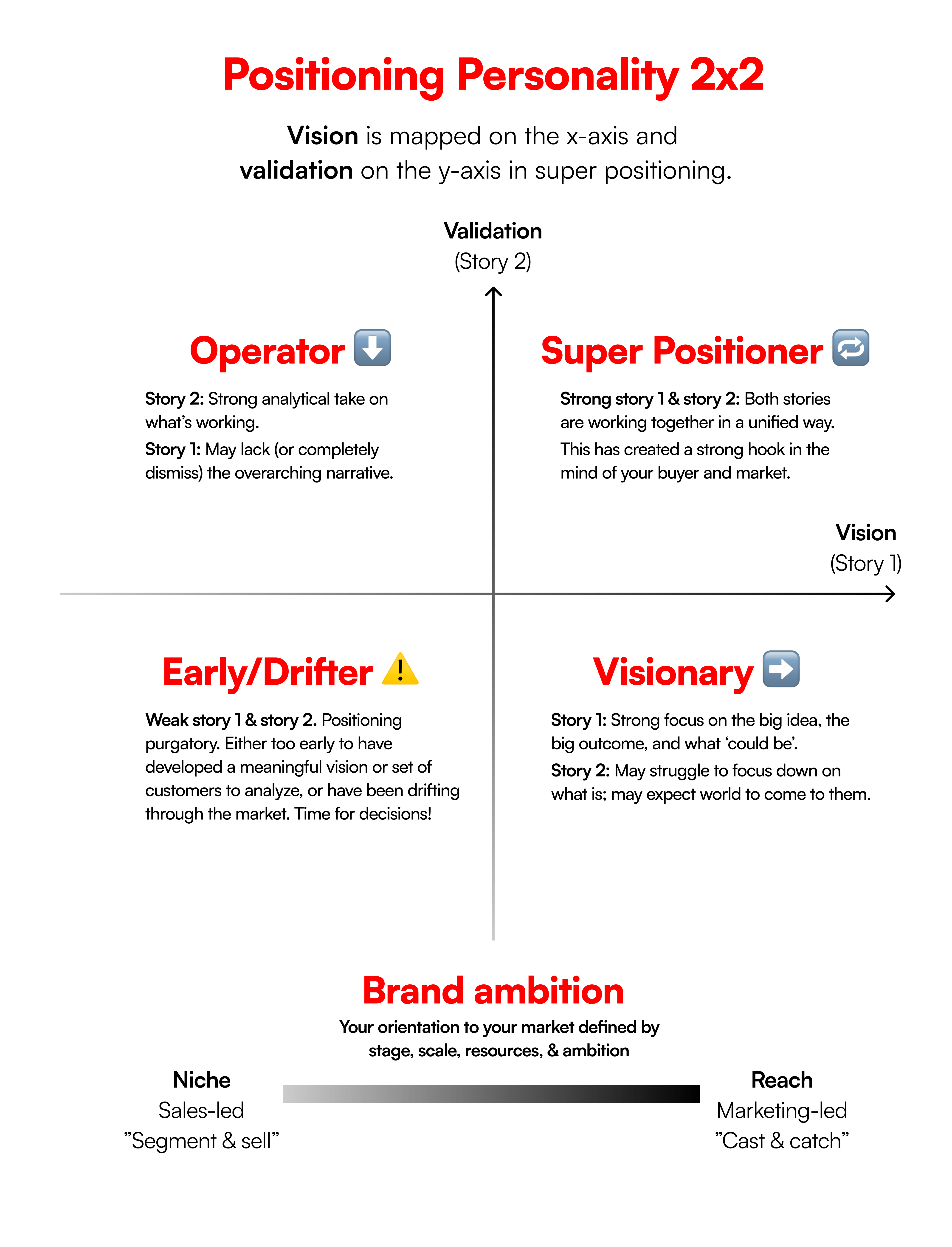
As you can see, this gives us:
- Super positioners: You’re scoring close to 15 and have nailed your story 1 and story 2 positioning across the vision and validation axes.
- Visionaries: You may be strong on story 1 vision but weak on down-with-your-customers validation.
- Operators: Or you may be excellent at understanding the story 2 customer-specifics, but struggle to bring a new vision to them.
- Early/drifters: You’re too early, or have been drifting in the market without much deliberate positioning, and are stuck in positioning purgatory.
Add on your brand ambition, and, for visionaries and operators, you might be a:
- Visionary with Niche Ambition: You have big ideas, but you’re happy to test them in a small niche.
- Visionary with Reach Ambition: You want to go all out and ‘create a category.’
- Operator with Niche Ambition: You’re happy to focus on a niche and take a very methodical approach to studying the needs of your ICP and gaps in the market.
- Operator with Reach Ambition: You’re about building sophisticated GTM plans to reach the mass market.
I know we all love to see ourselves in (often fairly dubious) personality quizzes, so don’t take this too seriously. Maybe it highlights some strengths and weaknesses, but the point isn’t to box you in. I want to show you the possibilities you may not naturally consider — maybe you should be more of a visionary! Maybe you should just focus on a niche! Keep those things you might otherwise dismiss in mind as we go through the rest of the book — you might be surprised what you’re open to by the time we’re done.
Compounding & the super positioning whole
Ok, great, we now (hopefully!) have a bunch of strategic specifics that we can work into your broader positioning. It probably feels a bit loose and disorganized at this point, and that’s totally fine. In the next chapter we’ll get more organized with your strategic narrative and then we’ll really boil things down for you strategic, customer-facing messaging in the chapter after that.
You might also have a sense of the kind of story you don’t have. And that’s fine — this is also a diagnostic exercise to see where you’re strong and were you could use help. There’s plenty of insights and examples to come to help you fill those gaps.
But where are we going with all of this?
There’s something bigger you need to keep in mind as the super positioning quarterback, too.
There’s a trick with this kind of analysis and workshop-style approach. I’ve been consistently asking you specific, comparative ⬇️ questions which is the domain of your narrow-focus attention.
In super positioning, however, the final step isn’t The One Right Answer, it’s about reintegrating those specifics into a new, unified whole.
I know that sounds a bit abstract, but it’s the difference between silver bullet thinking and compounding thinking. Everyone loves to try and zero in on THIS tactic or THIS approach or THIS feature that will take your growth to the next level, but the reality is always AND instead. And, and, and. Relevant AND useful AND memorable, for example. It’s bringing those most powerful ideas together and giving them time to marinate that helps you eventually build a company that’s just so recognizably that company.
Notion
Take a company like Notion, for example.
We’ll discuss this more later in the book, but they had a strong story 1 vision (user-built software and a highly novel product), they developed a clear story 2 pitch out of necessity (an initial focus on wikis, docs, and project management), and they wrapped it up in a very distinctive brand (including their visual assets).
And, and, and. That’s the compounding approach. Bringing these things together achieved the final brand goal of creating a memory association between a wide variety of productivity tasks and their product, giving them a lot of reach.
That’s the ultimate goal — bringing all three of these prongs (➡️ ⬇️ 🔁) together in a novel, unified, and compelling way.
Drift
Likewise, as we’ll touch on in our ride it chapter, Drift took an existing technology (web chat) in a competitive space and built a super position by very deliberately riding a wave (the rise of messaging — their story 1), finding a very specific differentiation opportunity in a specific industry (use chat, not forms, for sales and marketing — their story 2 ), and owning it with a very distinct brand (⚡️) and concept (‘conversational messaging’) that was, at the time, one of the most recognizable in the industry.
Strategic specifics to strategic narrative
Compounding choices are the essence of strategy and, ideally, that whole you build engages as much of your target customer’s brain as possible. That’s why super positioning is about engaging the right-brain radar, left-brain laser beam, and brand memory all in one unified whole.
But how do you get the team aligned around that, on the one hand, and have something to put in front of actual customers to get their reaction, on the other?
You need a strategic narrative, and that’s what we’ll look at next.
A special hello to you if you’ve come via LinkedIn. (If not, let’s connect!)
strat nav
That means not taking your strategic narrative and naively walking into sales situations, too. That is, even if — and perhaps especially if — your strategic narrative is story 1 heavy, your final sales pitch should not by default be a 1:1 copy of your strategic narrative.
The strategic narrative is more about your chance to capture your strategy and find the hook that will inspire buyers to explore your product and employees to join your mission. A final pitch deck, on the other hand, should be tailored to suit the attention of your prospects, and executives and end-users, for example, often use very different modes of attention. (I’ll show you how to tailor your narrative below.)
The difference between a strategic narrative and a final sales deck extends to the format and polish you apply, too. The good news is that here,
You can keep it pretty rough! In fact, you should keep it pretty rough!
But you do you! (And again a tip o’ the hat to Andy Raskin for pioneering the narrative-first approach!)
I like to think of this kind of hook or micro-pitch as your “Hemingway story.”
Ernest Hemingway, legend has it, once crafted a short story to win a bet with his drinking buddies. The bet? That he could make them cry with a story of just six words. The story?
“For sale: baby shoes, never worn.”
Your Hemingway story doesn’t need to make anyone cry (or roll their eyes, for that matter), but it does need to explain what you do with absolute clarity.
(I talk about the ’elephant problem’ to sum up the blind-men-and-the-elephant problem that positioning frameworks often suffer from, for example.)
For example, I have no idea if Tricentis did this, but if you were pitching “continuous testing,” you might have a maturity model that you can walk prospects through so they know you’re the right solution to take them through their first baby steps to whatever testing nirvana looks like.
Again, the mix of story 1 and story 2 you use will be highly contextual based on your positioning strategy, motion (inbound or outbound), prospect stage (high awareness late in the sale, or perhaps low awareness early in their journey), and prospect role (execs care more about change and what’s relevant to the company; end-users care more about what’s useful and what they can get their hands on).
But simply knowing the story 1/story 2 dynamic exists — and that the R/L/R jump is how we process information — gives us tremendous flexibility in tailoring our narratives to meet folks where they’re at.
I mention these approaches because ultimately this is about passing the hook test we discussed in chapter 3.
That means finding that catchy and succinct way of putting something novel on your buyers’ radar that speaks to your strengths and ultimately your unique theory of their success.
With that in mind, let’s dig into the super positioning approach to strategic narrative.
Let’s get into it. Here’s the preamble. (Feel free to use it in a workshop with your team, too.)
At a high level, we’re trying to build a position in the prospect’s mind so, in simple terms, they understand exactly who you’re for and what you’re about. To do that, your team has to align on what that position and message is.
The core ingredients for your strategic narrative, then, are our three basic super positioning prongs:
- Right-brain: Whether there’s new value generated by a new wave or a similar change-over-time story that makes you insanely relevant.
- Left-brain: Whether there’s unique value you’ve found that’s insanely useful to the prospect.
- Memory: Whether there’s owned value you can associate with your brand that makes you insanely memorable.
Note the recurring theme here is value. Your strategic narrative is essentially an expression of your core value proposition.
The new strategic narrative
Super positioning introduces a new approach to the sales-focused strategic narrative. One that — you guessed it — adapts the narrative to our two modes of attention as appropriate.
So for want of a better term, let’s call this approach the new strategic narrative, and this is where we turn your strategic specifics into a story with a beginning, middle, and end.
I’ll give you a basic outline for a typical B2B SaaS narrative below, but remember this narrative doesn’t have to do everything.
Consider our three prongs of super positioning in terms of deliverables:
- Relevant: Your strategic narrative is mostly (but not entirely!) focused on what you’re putting on folks’ radar, i.e., why you’re insanely relevant.
- Useful: Your homepage is more about capturing those ideas into a more left-brain, product-focused snapshot when folks are actively looking for a solution, i.e., why you’re insanely useful.
- Memorable: Your catchy brand hook is what you need to repeat consistently to help make you insanely memorable in the long term.
Each deliverable has a different ultimate job, and the strategic narrative’s main job, for our purposes, is to corral your strategic specifics into a form the team can align on.
Words before polish
We want words before polish. You can keep it pretty rough; in fact, you should keep it pretty rough! I like to think of a strategic narrative as a rough wireframe from which you can derive your final polished deck.
In a strategic narrative, there’s almost no imagery, the “slides” can just be spaced-out sections in a Google or Notion doc, and it’s a bit wordier than a deck a founder or sales rep might run through.
That’s because it really is just about the words and ideas we’re trying to capture. No distractions, no fluff, no procrastinating with fonts or charts, just the discipline of trying to hit headlines and bullets in a slide-style fashion, and put together a ~10-ish slide narrative that flows from start to finish.
If a positioning statement or spreadsheet is too cold, and a long boring strategy deck is too hot, I find the strategic narrative approach just right — the core ideas in an accessible format with just the right constraints.
2. Story 1 & story 2
Ok, you’ve hopefully got your big idea or a conceptual hook for your narrative.
Now, let’s think about how you’re going to position that hook or idea. Are you introducing something fundamentally new to your audience, or is it more of a competitive play against an incumbent or established way of doing things?
As I’ve been referring to, the foundation of super positioning is the hierarchy of attention which describes our two modes of attention. As a refresher, I use a story type for each mode of attention, giving us:
- ‘Story 1’ change stories for right-brain ‘radar’ attention — proving there’s new value from a new wave.
- ‘Story 2’ focused stories for left-brain ’laser-beam’ attention — finding unique value for a specific segment.
As I mentioned, strategic narratives are usually pretty story 1 heavy. In practice, however, how much of story 1 and story 2 story types you use in your narrative will vary based on your product and prospect. For example:
- Story 1: A cybersecurity product might talk much more about the emerging threat ‘out there’ (AI-enabled social engineering or prompt-injection exploits, for example). As a prospect, I need to understand what should be on my radar before any solution will make sense, so more of the narrative will be spent setting that context.
- Story 2: A developer-oriented product might get into the specifics of technical details, APIs, and integrations, and perhaps the challenge of build vs. buy very quickly. What’s ‘out there’ is far less important than the specifics of how it works, so we might lean more on a story 2-style pitch in that case.
Or, consider the typical exec vs. end-user pitch (and differences in attention):
- Story 1: A C-suite pitch (or end users when going outbound) might spend more time on story 1, the why, and the change-over-time narrative about megatrends that are likely to impact their organization, setting up the new value that comes from these new waves.
- Story 2: An end-user pitch would focus much more on the how, how the tool works and how it affects their day-to-day, so we’d lean more on the story 2 pitch.
Your turn
- With that in mind, are you leaning more on story 1 or more on story 2?
- If you had to put a percentage on it, are you thinking 70% story 1, 30% story 2, or vice versa, or something else?
- No right answer here, it just helps frame the job you want your narrative to do, and who it’s for.
Workshop tip: An illustration I like to use here is the claw game or UFO catcher you find in (what passes for) arcades today. You know those ones with the fluffy toes you have to try and win? They work by going out on the x-axis and then down on the y-axis to grab the prize. The same is true in positioning. Sometimes you’ll need to go out much further on the story 1 side, while other times you’ll need to drill down more on the story 2 side to ‘win’ your prospect’s attention. I’ll give you example outlines for both, too.
Category creation is an incoherent mess of ideas that never really made much sense, but captured an important vibe about being, well, catchy. Being
Positioning is about competitive alternatives, and the villain of this book is category creation.
So why is the subtitle of my book: Category creation is dead. Build a super position instead?
In my big, textbook-length Positioning Playbook I wrote a mini-book on why Play Bigger is actually a very silly book
When positioning gets too narrow, we can end up spending too much time looking down trying to split hairs between competitive alternatives rather than looking out at what can be genuinely different. And we’re discussing those big change stories here, after all.
Category creation suffers acutely from the same confusion. In my experience, category creation can mean either:
- Traditional software categories, i.e., literal groupings of similar things. This is usually narrow-focused sub categories, or hair-splitting differences with existing categories, and is a product of left-hemisphere attention. (E.g., a real example I’ve seen confuse buyers: “We’re not an LMS (Learning Management System), we’re a LXP (Learning Experience Platform)!”)
- New category concepts that aim to transcend a literal category and reflect some change in the world, which is much more a product of right-hemisphere attention. (This can include truely unique companies like IKEA that become cultural touchstones in a category-of-one sense.)
Again, one is a narrow focused question looking down at where you fit on the map; the other is looking out and up at how you transcend the map entirely.
They are very different definitions. Investors tend to lean on their right-brain attention (it’s their job to know what’s ‘out there’ after all), but founders and CMOs often grab the wrong end of the stick and then start thinking about literal categories of software.
Now consider that “category creation” is just a concept generated by consultants (no shade, that’s what I’m doing here!), it’s not some iron-clad law of the universe. If you actually scrutinise the work (which I did in Positioning Playbook), you’ll see it’s about as robust as a soggy Kleenex.
But that’s not the point. The point was that it was designed be catch on above all else in a memetic sense, and it was very successful in the regard!
Why did it catch on? Why was being the category creator a memetic idea that investors in particular loved?
The Sand Hill Road scene
Here’s how SaaS legend Dave Kellogg, writing in 2022, described Play Bigger’s arrival:
Play Bigger hit the [Silicon Valley] Sand Hill Road scene in a big way after its publication in 2016. Like Geoffrey Moore’s Crossing the Chasm some 25 years earlier, VCs fell in love with the book, and then pushed it down to the CEOs and CMOs of their portfolio companies.
And what did these lucky CEOs and CMOs then encounter?
The Play Bigger authors humbly submitted that, in the great tradition of American pop business books, their theory of category creation explained all business success ever, and indeed more or less all human success ever, from Google to Gandhi. Really.
Unfortunately, it turns out there isn’t much you can learn about B2B SaaS by trying to draw a line between Elvis, Paul the Apostle, Lenin, Peter Drucker, and Salesforce.com. (Yes, that’s really what Play Bigger does.)
I think we deserve serious frameworks grounded in reality, not a fever dream that sounds like the start of a corny joke. (A Christian apostle, a Marxist revolutionary, and a SaaS CEO walk into a bar…)
That’s why, with super positioning, rather than taking a top-down approach of trying to find some commonality between Everyone Who Ever Did Anything Great Ever, we take a much simpler approach of working from the bottom up and how our brains attend to the world around us.
Play Bigger created a whole playbook built around this need that culminated in finding a “category name.” As far as I can tell, what they practiced was somewhat different to what they preached, as we’ll see in the next chapter, but either way I find this approach flawed and confused. It means different things depending on your mode of attention; thousands of categories already exist; and it doesn’t capture what truly generational companies do, anyway.
Bonchek’s approach was that the story could do everything — vision, strategy, culture, inspiration, the works.
Raskin’s approach was that the narrative should almost exclusively be framed by one thing, what we call the story 1 change story — a big change in the world.
We’ll discuss Raskin’s approach later when we look at the three prongs of super positioning, but the innovation we’re bringing to the strategic narrative is tailoring it to your story 1 and story 2 pitch.
19/9
In this case, you might argue that Apple didn’t invent the VR headset category, but by attempting to do something singular with the Vision Pro and their concept of ‘spatial computing’ they — metaphorically at least — were creating a new category of VR headsets, or trying to at least. (Will bulky face computers ever really be a thing?)
Here, people tend to start with the outcome — the category name — and try and work backward from that. Or, they try and use it as cover for their very incremental innovation. It’s as though you can make the Nth flavor of some staple of corporate software (CRM, HRMS, LMS, ERP, RDBMS, etc), come up with some made-up category name for it, and hey presto, you’re a big innovator and you now have something to put on folks’ right-brain radars.
That’s great, except for the fact that the market sees right through it and you are the one that ends up high on your own supply. And because you’ve convinced yourself of something that isn’t real, you cut yourself from reality and your ability to see real opportunity if and when it emerges.
Now, as much as I love turning everything into binaries, please understand this isn’t a case of CATEGORY GOOD/CATEGORY BAD.
Category creation does happen. G2.com currently lists more than 2000 categories for B2B products, as mentioned, and at some point, they had to be created. There really was a time when inventing the “pet care” SaaS category was a new and crazy thing to do, and that’s awesome.
New categories also still emerge all the time. “AI coding software” and “AI meeting notetaker” are both hot new categories as I write, and if you happen to be pioneering those categories (or whatever the hot category du jour is), more power to you.
But those categories were emergent, not confected, and with 2000+ B2B tech categories already created, again, I think it’s fair to say ‘creating a category’ itself, in the literal sense, isn’t a dominant strategy anymore, even though creating a truly unique product and company always will be.
Why?
Well, waves of technology create waves of change, that change necessitates new playbooks and solutions, and those new solutions will find their way into specific categories. Therefore, there’s always some natural interest in new categories of software in a literal sense (hence the 2000+ categories on G2), and in new playbooks that get lumped in with categories, in a more metaphorical sense.
In my view, this approach works when there’s a wave to ride (as we’ll discuss) or a genuinely novel concept you can put on folks’ radar… and the product backs it up.
That’s what worked for Qualtrics — the concept (measurable experience) and product (survey tools) worked hand in hand to create a new whole around the XM brand. Right-brain and left-brain attention came together to create something greater than the sum of its parts, and that helped them build towards a dominant position over a number of years. (And it does take years!)
In cases where it doesn’t work, there might be a reasonable right-brain narrative about a new way of working in a particular role or function, but if it doesn’t connect to the product in a meaningful way, or translate into a new way people do their job, then it’s always going to be difficult to land.
This is especially challenging when the big idea truly is worthwhile, it just doesn’t connect to the product. One of my clients struggled with exactly that — they had a big theory for how a particular corporate function (L&D) should work, but that didn’t connect directly to the product (an LMS) they were trying to sell. If they were trying to sell consulting, however, it might have been a different story, but that’s often not why folks get funded in the first place.
The operative metaphor
Categories — and winners of those categories — do emerge; VCs need a way to convey to founders (and their CMOs) that that’s what they want from them; and “category creation” became, for a while at least, the operative metaphor for that kind of positioning and ambition.
Play Bigger deserves full credit for putting ‘put something truly ambitious on folks’ right-brain radars’ back on, well, folks’ right-brain radars. Sure, some of the explanations attached range from wishful thinking to “studies” so skewed they’d make a McKinsey consultant blush, but the intention was there.
(The category creation folks, by way of contrast, think 100% of winning companies ‘create a category,’ which is a silly and easily refuted claim, but it serves to highlight the attention preferences at play here.)
Some folks lean heavily into the right-brain approach; some lean more into the left-brain approach, and before I came across McGilchrist’s hierarchy of attention, I assumed these approaches were entirely incompatible. But now, I understand we need to use the appropriate amount of both modes of attention. And, when we look at your sales narrative next chapter, we’ll also look at the way we can sequence these two modes of attention using the right/left/right jump.
===
You may or may not have heard of category creation,
That’s the subtitle of this book, and I chose it for a very specific reason — positioning!
Positioning is about competitive alternatives, and super positioning, in that sense, exists as a competitive alternative to category creation. It provides both:
- Maximal outcomes: A new way to think of maximal startup outcomes — companies that create a ‘super position’ in their market (not a ‘category’).
- Minimal starting point: A more grounded way of incorporating the path they took to get there (often starting in a niche, not naming a category).
That’s the think big/think small nature of super positioning — it’s not either/or, it’s both.
And, as you may have guessed, those two ways of thinking — the maximal outcome and the narrowest starting point — are, again, products of those two pesky modes of attention, with super positioning existing above them. (Hence “super” like “superscript.”)
But why is ‘category creation’ dead?
Positioning love
The key to everything — and I mean everything — is that the confusion stems from how we ‘attend’ to the world around us.
It turns out we actually have two quite different modes of attention that are products of our left and right-hemispheres. Both hemispheres are involved in everything all the time — this is the new science of attention, not the old pop-psychology split brain stuff — but each has their own unique ’take’ on the world.
And from those two takes, along with memory, we can derive:
- The major approaches to positioning (the ‘go big’ narrative/category creation school and the ‘go niche’ ICP school).
- The powerful ideas you need to drive your positioning (relevant, useful, and memorable).
- The two types of stories that match each mode of attention.
- The four strategies that result from these modes of positioning.
It’s a lot! And it all comes out of this little idea about our two modes of attention. Our right-hemisphere acts as our radar with a broad, open awareness to those big ideas that are ‘out there’ on the horizon and our left-hemisphere focuses down on the parts and pieces, the detail, the map and categorization. The work together to bring information in on the right, process it on the left, and reintegrate it back on the right.
That’s the hierarchy of attention from famed psychiatrist, philosopher and neuroscientist Dr Iain McGilchrist, and it underpins everything in this book, everything in positioning itself, and perhaps just about everything in the way we function as a society and a species.
How could it be otherwise if this is the fundamental nature of attention we use to engage with the world?
Finding the balance
The fact that there are two modes of attention created a bit of a conundrum when I was writing this book. I was faced with a choice:
- I could go for maximum relevance and hammer the change story — after 50 years of business writing on positioning, we now have useful science that explains how it works!
- Or I could go for maximum usefulness and get you applying these ideas as fast as possible without having to know every detail about them.
In this book, I’ve chosen the latter. (If you’re a massive positioning nerd like me and want a deeper dive into the ideas and their application, check out my textbook-length _Positioning Playbook.)
That is, you’re entirely free to choose your own positioning adventure, but I’ve put the hands-on stuff first so you can learn by doing.
Category hate
Transcending categories
Super Positioning isn’t a rah-rah book about great companies (although they are all great inspirations), it’s a book about focusing your mind on the maximal outcome — the super position in your market — while getting down into the weeds of that initial narrative, positioning, and messaging that ignites the fire that will drive your growth.
So that’s where we’ll start. That’s what Super Positioning is about.
First, however, I’ll briefly introduce myself and then we’ll get into our first challenge: do you have a hook?
Let’s go!
Exploring the foundations
Finally, for you big positioning nerds (high five!) we’ll explore the foundational ideas of super positioning, including:
- Vision: …
- Attention & vision: … [combine? attention -> vision]
- Category creation: …
- The three prongs: …
- Positioning 101
18/9
combine it
Now you just — just! — have to execute. If you can empower your product teams and ship fast, you can build and sell your way to an incredible outcome.
Zuora, for example, who went public in 2018, built a narrative around the “subscription economy” which apparently helped in deals (and became the basis of the Andy Raskin’s “strategic narrative”). That is, they nailed the narrative aspect of their positioning. But ultimately, I wouldn’t say they built a super position.
I don’t want to take anything away from what they’ve achieved — only a tiny fraction of startups go public, after all, and it’s incredible they’ve built the business they have — but their shares currently trade at less than half of their IPO price, and the stock has slowly sunk (with an exception of the COVID rally) over the seven years they’ve been public.
Their narrative might have been instrumental in helping them get that far (which is, again, amazing), but ultimately they never made it to ‘own it,’ in a position-in-the-mind-and-market sense. Their “subscription economy” concept took them a long way, to be sure, but it just didn’t catch on in the same way, say, “payments for developers” did.
But that’s the harsh reality of business.
Some companies, on the other hand, are lucky enough to have the pieces fall into place.
HubSpot, for example, (to bring us full circle from the introduction) went public relatively early in 2014 and, COVID bubble notwithstanding, has ~20x’d their stock price in that time. They ultimately built a compounding super position, including a pivot to CRM, that’s taken them very far indeed.
But even HubSpot, as we saw, couldn’t reproduce their initial (so-called) category creation magic after inbound marketing, because those waves of opportunity are unique.
own it
You can see shades of the actual Play Bigger playbook we discussed in chapter 8 — coining a new term (“GTM engineering”), declaring it a new discipline (as Clay have done on their blog), and going all in on it (building the concept into their raise announcement).
Brand obsession
I think a high standard for what is or isn’t on-brand is a generally healthy thing for all companies to aspire to; however, it’s worth noting the failure states for brand, too.
Overemphasizing brand in enterprise
Products with great brands tend to just be nicer because the founders (often designers) have a taste for it, and users who appreciate it can get hands-on and tell other folks to try the product. This can work well in the UX-driven, product-led growth world if your UX really is that remarkable, as Linear’s was and is.
In enterprise SaaS, however, the process is sales-driven, not necessarily product-driven, so thinking UX-as-brand will save you is a mistake. (There are billion-dollar enterprise companies with 2010-wave Wordpress-looking websites out there, for example.)
But there’s still a brand opportunity!
Think about the memory associations buyers form when they interact with your sales team and eventually do get hands-on with the product — how consistent is the message? How insightful is the rep? How positive is the experience? Does the final outcome in terms of ROI match the promise? There’s still a promise to be fulfilled, and that’s where brand memories are built.
Obsessing over brand meaning
‘Chief Brand Officers’ sometimes get carried away applying their own attention to the meaning of your brand, or even just your logo, developing wild theories about brand personalities and traits. It’s loved! It’s your badass friend! Those geometric shapes really do capture our corporate values!
As the kids say, sometimes it’s just not that deep.
The acid test for this overtheorizing is whether any customer would actually ever describe the brand in those terms. You can survey them and see!
What matters more is recognizability and consistency — it’s often experience that drives brand meaning (and memory associations), not vice versa, which is putting the cart before the horse. Apple didn’t become Apple because they once ran nice brand ads, they became Apple because of the consistency of experience people had with their products over years and decades.
To add insult to injury, B2C marketing academics say that incumbents — contrary to popular belief — tend to have slightly more loyal customers in proportion to their market share. (This is the ‘double jeopardy’ law Byron Sharp and the EBI folks often talk about — smaller brands reach fewer buyers, and those buyers are slightly less loyal.)
Building memory associations in the market such that a steady stream of buyers will come to you simply because they happened to think of you takes a long time.
You can measure progress by watching your direct brand search traffic grow over time, but remember this is the byproduct of everything you do — your paid ads, your social posts, your sales outreach, your media efforts, and of course, the customers you’ve served over the years.
But all that effort has to actually create a memory association in some plausible way. Far too many marketing teams spend time writing blog posts that no one reads or posting to the void on LinkedIn and beyond.
This comes back to the super position you’re trying to create — it’s not enough for people to recognize your name (though a lot of marketing activity fails at even that) — there has to be something worth remembering and a clear need to associate it with.
(This kind of brand building is also somewhat meaningless if you haven’t found product/market fit yet — hard to build memories around a need before you’ve established what that need is.)
Branding through clarity
find it
Earlier, we discussed how the term “positioning” is just a metaphor for staking out some point that’s different from others. That could be a ‘position’ in the buyer’s memory (being first to mind), a ‘position’ in the market (determining your company strategy), and so on.
Even the verbs I use in my positioning mantra — that is, the point of positioning is to be known, chosen, and remembered — are all specific ‘jobs’ that people ‘hire’ positioning for, to use the JTBD jargon.
One of the main ‘jobs’ positioning itself has to do is to show how you compare to alternatives, which is why competitive positioning is the second prong in the super positioning system.
It took me forever to realize that my persistent irritation with Play Bigger and their Google-to-Gandhi category creation shtick wasn’t something I should just bury in a rant in a late chapter; it was the old way/new way angle I was looking for.
In a macro sense, the classic application of this approach is vertical SaaS, as we touched on before. A product built for a vertical to meet that vertical’s specific jobs-to-be-done is often a recipe for outsized ICP value.
Find uniqueness, build uniqueness
Most startups (and tech companies more broadly) don’t have a problem with being too unique, however. The point of your positioning, and the point of writing down your ‘strategic specifics,’ is to highlight what makes you unique specifically, so you can focus on that as a differentiator, and ultimately improve the efficiency of your GTM motion.
That’s great, but we can go further.
By focusing on the jobs-to-be-done themselves, you can map out all your customers’ needs. That can then inform your innovation and product roadmap as you think not just about your differentiation in the here and now, but the scope of the workflows you’ll aim to cover over time.
GitLab, for example, are the most rigorous (at least publicly) I’ve seen in their use of JTBD, and their handbook provides a nice introduction to how they think about it. They put the left-brain laser beam to work like few do, and if you want to see what JTBD looks like in action, that’s a great place to go for inspiration.
This Jobs-first approach, however, also helps you think through your competitive trajectory. If you find you’re just hillclimbing a hill that a competitor already has covered — you’re solving the same jobs in the same way — then you can ask yourself if that’s really the winning path you want to be on.
Maybe it is, and it’s the cost of doing business, but maybe it’s not, and you start thinking more about innovation and differentiation, or even niche focus, so you can build something that’s increasingly differentiated in the future, too.
Focus on what’s real
This kind of analysis is obviously very useful — it pays to take stock of where you’re at, what’s unique, and what that means for your positioning and future roadmap.
This approach is also fantastic for making positioning legible at all.
- If you’re a marketer and have never thought about positioning, having a simple table or document to fill out is a great start.
- If you’re a company that’s been in the market for a while and you feel like you’re drifting, just taking a fairly random path, taking the time to stop and do some proper analysis can be a revelation.
- If you’re a customer trying to buy a product or platform and you’re in left-brain analysis mode, then matching that to the vendor’s left-brain analysis can be very helpful.
They are all times when a narrow approach pays off — strip away all the complexity, focus on a few simple things, and go from there.
Perhaps the biggest benefit, though, is that this kind of focus reveals what is working, not what you speculate what might be working or could work in the future. The big picture right-brain stuff is often about the dream of what could work, in a change-over-time sense.
But this left-brain step is, again, about the here and now — the real value your product is generating today, the ICP that gets that outsized value today, and the language you can reflect back to the market today. That’s powerful stuff precisely because it’s real; it’s not empty hype or speculation. That’s why it’s so valuable for startups — startups begin with a hypothesis and, sooner or later, you have to assess the results and the particular kind of value you’ve created.
If you can then position about that real value — and not just your initial hypothesis — then you can potentially grow even faster.
If that helps you nail your positioning, great!
That’s the strength of the left-brain laser beam.
The weakness, however, is that it can be, well, very narrow.
Map vs. territory
Everyone loves the idea of a nice, neat table or spreadsheet, and of course, templates can make great starting points for your own analysis (and, for better or worse, LinkedIn bait).
But the map is not the territory, as they say, and McGilchrist warns of the left hemisphere being very inclined to tell you that its map is indeed the territory.
In reality, the gap between the map — the table, canvas, or spreadsheet — and the territory — where you apply your vision and genuine insights are found — can be quite wide indeed.
That is, in part, why I like to start with a narrative instead of a spreadsheet. It doesn’t have the arbitrary restrictions of a table that you have to fill out; you have more freedom to describe your unique value in your unique context.
It also helps you avoid the value blob of just trying to roll incremental value propositions together as though that’s your positioning, as we looked at in chapter 5. You need a hook to hang all these value statements on. That requires a big idea you’re putting on folks’ radar in the first place, and that’s not always found at the bottom of a spreadsheet.
Super positioning = R + L + R
Back when we were looking at your sales narrative, we discussed the right/left/right-hemisphere process (a.k.a. the R/L/R jump) our brain uses to attend to the world and process information. We’re smack bang in the middle of that process here, but I want to stress that it’s not the sole positioning process.
It’s a crucial one, to be sure, but we’ve got the other two sides as well — what’s new that we’re putting on folks’ radar and the new whole we’re building, which we’ll look at next chapter. They’re the other two prongs that make up the three prongs of super positioning.
Don’t get me wrong — analysis and narrow focus are powerful tools. It’s an essential step in the R/L/R jump. You don’t go from big idea to new whole without it, and indeed I’ve been very critical of the category creation approach because it’s all R and no L, all big idea and no feet-to-the-fire specifics, if I can put it that way.
Super positioning is about both modes of attention working together — the big idea and the analysis of the jobs-to-be-done impact so you can build the most compelling hook possible in the mind of the buyer.
That makes it less neat than just a spreadsheet-as-homework-assignment that competitive positioning can sometimes boil down to. But we want to win and to do so, your positioning needs to take into account both right and left-brain attention, so don’t neglect your narrative, which is where you can bring these ideas together.
Either way, remember to look for the hook. Fathom Analytics does a good job in that sense — “A Google Analytics alternative that’s simple & privacy-first” tells you exactly what it is and why it’s different. It’s a hook and not a value blob because those attributes all compound, they all add up to a gestalt that makes sense. And it works because it’s built on specific attributes they — and their customers — care about.
Building your gestalt
If you study the positioning literature, you’ll find that positioning has, in a sense, always been about finding your attribute(s) and what you can be ‘more about’ than the competition. That includes Ries & Trout’s various theories and “laws” — there were a lot of them because there are a lot of attributes to theoretically own in the mind of the buyer.
In a sense, all the ideas we’ve been discussing around your hook, category, strategic narrative, competitive positioning, or point of view all come back to trying to find something to hang your hat on. Some unique set of attributes, some kind of gestalt to create some level of distinctiveness (I use the term advisedly!) in the market and the mind of the buyer.
The point of all this is to get us to our third prong — an owned memory association in the mind of the buyer, as we’ll see in the next chapter.
The power of your chosen technique, however, comes back to your customer vision and your theory of customer success. That is, the leverage you create in the market through positioning comes from the leverage you can create in your customer’s world, i.e., how awesome you are.
Being awesome
One of the great things about Dunford’s work, and her book Obviously Awesome, was the hook. Positioning was about being obviously awesome for a set of buyers. That’s a very handy rule of thumb to keep in mind when thinking about your positioning!
When we talk about finding unique value in a niche, that’s what it’s all about. It’s easy to pick a fuzzy attribute and kind of hope for the best, but that rarely makes you awesome. Sometimes you’ve got to crack out the laser beam, do the proper analysis, think really hard about where that 10x awesomeness can come from, and then go all in on it.
ride it AI
The AI wave
While the narrative around AI has been, at times, filled with so much hot air you could probably travel around the world with it, there have been actual, productivity-enhancing B2B tools created (developer tools especially), along with an avenue for future productivity growth (better models and their application), which is what we care about in the B2B world.
Personally, I use LLMs for all kinds of things — proofing this book (spot a typo? Blame Claude), ideation, image generation, Q&A, health consulting, code generation, voice narration, and plenty more. (No writing though, eiw.) It’s just fun to play around with.
The key question, in B2B terms, however, is whether we can take this co-intelligence from “fun to play around with” to “delivers meaningful, sustained productivity improvements for the enterprise.”
How do we get there? How do we prove that out? This is where wave-riding, as a positioning strategy, only works if you’re equally dedicated to looking down on the left-brain laser-beam axis to the actual specific value of your tool or solution, not just out on the right-brain radar.
I’m super excited about all the possibilities for fresh innovation that the AI revolution has launched, and I’m a big believer in how Ethan Mollick describes modern AI as a co-intelligence we need to learn to work with.
Use it to prove it
Detour over, back to proving value on a wave.
Currently, there’s an incredible amount of pull from the market to put AI to use in helping folks with the jobs they want done and an incredible push from investors who see markets in land-grab mode and are happy to dole out $100M investments to AI PhDs who so much as sneeze.
This can put marketers and founders in a tricky position.
On the one hand, there’s incredible pressure to fake the wave — raise too much money, with too big a narrative, and go along with the theater of automating all work forever (for real this time!) while failing to do the left-brain laser-beam work on what productivity improvements can actually be proven, because that level of scrutiny threatens the big right-brain narrative.
On the other hand, when there’s so much demand here and now, if you wait around forever forensically proving every single productivity improvement, the wave will pass you by. What can you do? What should you do?
In my view, the best founders will see the hype and use it to prove it. You use the wave to open the doors, be ushered into companies and departments all over the world in almost any conceivable sector, and then apply your vision to methodically prove out your value for concrete jobs-to-be-done, capturing the way your customers innovate with your tools along the way (as we’ll see in the next chapter).
This is the classic, collaborative, early stage, work-with-design-partners approach that balances early adopter enthusiasm with the pragmatic reality of what the technology is currently capable of. By all means, put your flag in the ground about where you want to go — paint the big picture — but then get back to building with real customers on real jobs-to-be-done.
Detour over, back to proving value on a wave. Let’s now look at some of those examples we can learn from, starting with well-funded AI-first companies.
Perhaps the biggest question for venture-backed AI startups is: where will the value accrue on the B2B side? Will the winners be:
- The foundational model companies?
- The infrastructure companies one level above?
- The classic B2B SaaS-style platforms for enterprises?
- The end-user PLG plays?
That remains to be seen — perhaps the foundational model companies are the category that will capture all the value, with OpenAI and Anthropic already doing billions in annual revenue.
But, personally, I’m more interested in the application layer, and we’ve already seen breakout PLG hits like Cursor and the whole category of AI-first IDEs.
Likewise, in the more classic corporate B2B SaaS sense, we’re seeing new categories of LLM-based tools emerge that aim to solve the jobs-to-be-done of a given industry in whole new ways, both speeding them up and, sometimes, automating them entirely.
This is where it comes back to vision. For example, as we’ll see with HubSpot in a moment, sometimes the initial niche positioning in a vertical doesn’t work, and casting a bigger net by going horizontal does work, because that better matches their vision.
This is where one-size-fits-all positioning advice can be dangerous. What’s important is understanding the positioning fundamentals you have to work with — niche and reach, segment & sell vs. cast & catch, and the things that are contextual to you — your vision, your market, and your resources.
Just don’t forget you have to prove your y-axis value on that x-axis wave you’re riding.
From niche to reach
For most B2B startups, though, the traditional approach is to go from niche to reach as we’ve discussed — build from a modest start in a very narrow niche and expand your reach slowly over time.
But when there’s insane amounts of capital being thrown at AI companies — including ones at the application layer — then the math is a little different.
===
… don’t expect you to have totally nailed it
… maybe final super positioning checklist? putting it all together/ … hook (one idea) / specifics (3 col list) / narrative (10 slides) / web (5 min test) / brand hook (one idea) (full circle)
… simple chapter 1 page to refer back to <– should do this, would make info graphic … extremely useful (manip) or extremely relevant (change)
… just getting started! that was the warm up. … strategies next -> how do i stretch R, do L, do R, combine
… fundamentals beyond CC
… just where we were, how to create conviction
… which should we do more of - story 1 or story 2?
I threw you in the deep end with the practical stuff here, and if you want to take a breath and get up to speed with the fundamentals of positioning before going too much further, that’s what the next section is all about, so keep on reading.
messaging
Structuring your pages
If you’re planning on reworking your website to reflect your updated narrative and positioning, here’s a quick guide to how I think about it:
- For homepages, I like to express your narrative and positioning in a value → product way (i.e., once we’ve covered “What the hell is it?” the emphasis is on the value or outcome as supported by the product).
- For product pages, I flip that around and focus more on the nuts and bolts of the product, the key pillar features, and what they deliver. Here it’s worth thinking about the full product loop. What does a high-level take on a typical workflow look like?
- For solution pages, if they’re necessary (if you’ve got a strong vertical focus, your solution & product pages might be the same thing), I like to treat them as mini-homepages with more license to get into the details and nuances of the relevant jobs-to-be-done, customer language, and role or industry-specific outcomes you deliver.
We’re just going to focus on homepages and brand messaging here — just remember you don’t have to jam every possible thing in. Resist the value blob.
Messaging is a creative act
While balancing the type of story you want to tell with the story you need to tell can be a balancing act, remember this is a creative activity, so don’t get too caught up in the One True Best Way to put your homepage together.
Again, there are plenty of opinions on what works because there’s very little actual science or real proof on approach X vs. approach Y. That’s why first principles and knowing your customer matters.
I know it sounds trite, but it really is best to do whatever makes sense for your market and your buyers, speaking to the strengths of your particular product (or product suite).
For one client, for example, I ended up creating little product portals on their homepage that acted as a gateway to the full product/solution page. Each portal block had a relevant case study, a testimonial pull quote, and a set of buying guides that would help teach buyers what they needed to know. They were the ingredients we were working with, so I made the most of them.
Again, don’t just follow templates, bring what matters together for buyers as a service to them. Think hard about what would actually help them buy!
specifics
That is, specifics are vital, but it’s not because we’re talking about one weird trick or silver bullet that solves positioning. We’re not even talking about a three-word hook like we touched on earlier.
Instead, these strategic specifics matter so much because they compound to build a new, unique whole (rather than yet-another bland, same-y B2B brand).
That is, ideally you’re insanely relevant, insanely useful, and insanely memorable
intro
The only problem is, despite some notable successes (and we’ll cover why they succeeded in our 110.ride_it/‘ride it’ chapter), the theory behind it is completely incoherent and that led to many people — marketers especially — grabbing the wrong end of the stick.
“Category” is just not a useful lens to view the world through, and I’ll pull it apart later in chapter TODO if that floats your boat. It’s much more interesting to think about how you can rise above your category altogether.
That’s why I describe companies that stand alone as having a “super position” in the market — one that doesn’t necessarily create a category (there’s already 2000+ B2B tech categories!) but transcends their notional category altogether.
This combination of both right and left-brain attention applied to positioning is surprisingly rare. Most approaches — and most experts — end of focusing on one or the other.
But what happens if we use both?
17/9
Narrative
So when we talk about applying the specifics you wrote down in the last chapter to your narrative, we’re going to lean more on the story 1 (➡️) change story here. In the next chapter looking at your web messaging we’ll lean more on the story 2 (⬇️) specifics.
This isn’t a hard and fast rule, but narratives are also great for internal team alignment and this is a great chance to align on your narrative (➡️) story 1 specifics.
Narrative ingredients
This is a choose-your-own-adventure moment, too.
I’m assuming here you’ve got a bunch of specifics to work with after going through the questions in the previous chapter.
If that’s the case, great, let’s push on!
If not and this feels premature and you still need some time to think through what exactly you see or what you should be looking for, feel free to jump ahead and read the strategy chapters first — ride it, find it, own it, and combine it — and then return to this chapter afterward.
If you’ve got a good handle on your vision (don’t miss the vision chapter either) and have some potential hooks in mind, though, this is as good a chance as any to get things down and start writing!
Narrative-first positioning
Super positioning is fundamentally about narrative-first positioning. We process information from the right-hemisphere first (as we’ll discuss) and a narrative also helps us:
- Tell a whole story, from beginning to end, whereas a homepage (for example) is more about getting folks to just take the next step (like trying the product or booking a demo).
- Tell a rich story, as opposed to a details-free positioning statement, especially in a sales context where you have more time and more of the prospect’s attention to work with and can explore pains & gains in more depth.
- Tell a custom story, which you can tailor to your audience and their role (e.g., end-user vs. C-suite).
You can also have a sales narrative without a sales deck at all if you’re product-led and don’t do sales per se; just call it your positioning narrative (or master narrative, or strategic narrative, or whatever you like). What you call it doesn’t matter; what matters is how you express your value proposition.
So, first things first, what’s the value you have delivered? What have you proven out? What did the customer say?
Avoiding mismatched pitches
The story 1 vs. story 2 distinction helps avoid a classic B2B GTM failure state.
One startup I worked with spent a decade focused on the end-user story 2 pitch… but never really cracked the story 1 exec pitch. Execs don’t really care about a workflow they never do day-to-day, and the startup struggled without a narrative to connect their product to the bigger picture execs do care about.
The Unicorn, on the other hand, went big on the story 1 change narrative, as we discussed, but it didn’t resonate with end users at all — it was about organizational transformation that was well above the front-line folks’ pay grade.
What matters in these pitches is that your attention — your vision — intersects directly with your prospects’ vision, literally what they’re looking at day-to-day. If you can match what they see and appear to ‘read their mind,’ then you’re golden — you’ll win and keep their attention because you’re directly addressing their interests.
This is the vision feedback loop where the more expertise you get at delivering that final value, the stronger your positioning and what you ‘see’ ultimately becomes.
As a final bit of context-setting, the R/L/R jump is a simple way of understanding how both modes of attention work together in both creation on the startup side and buying on the prospect’s side, and that’s something we can harness for our narrative.
===
They’re the three hooks we want to cover, but before getting into the weeds its worth establishing why positioning — and specifics in particular — matter at all.
This requires being specific about which questions matter, too. You don’t need to answer all of them; you just need to be specific about the ones you do! So be sure to go back over those questions above and highlight the ones that matter.
- ➡️ Narrative: Can you get specific about a change in the world, position around that, and ride that wave all the way to a multi-billion dollar market cap (HubSpot and inbound marketing)?
- ⬇️ Positioning: Can you spot a customer doing something weird with your product, get very specific about that, and turn that found insight into a near-billion dollar acquisition (Loom and short video sharing)?
- 🔁 Brand: Or can you get specific about the way and style you serve a particular need (like building websites), and get very specific about how you tell people about that (Squarespace advertising on every podcast, ever).
Asking the questions is easy (my job), having the answers is the hard part (your job).
But I’m here to help you with that job as much as I possible can. The rest of the book exists to help you:
- Think through what positioning looks like (from positioning 101 to category creation).
- Think about where your ideas will come from (your vision and, later, our four strategies).
- Turn your answers to these questions into something you can actually put in front of prospects (a sales narrative, which we’ll look at next).
That’s the super positioning system we’ll be developing throughout this book.
===
It might be something you do solo or you might quarterback the process with your leadership.
===
The positioning world tends to divide itself by these two modes of attention.
On the one hand, for a time at least, the tech world used the term “category creation” to represent that first kind of thinking — “category creators” were the ones that achieved that maximal, or “generational” outcome as the multi-billion dollar mega company.
On the other hand, startups are about starting up, and no company starts life as a multi-billion dollar conglomerate. Therefore, “positioning” is how we describe finding that best-fit industry niche, ‘ideal’ customer, or specific problem to solve that gets you a foothold in the market and a place to start building towards that billion-dollar outcome.
You can see how these two approaches map to our two modes of attention.
But like our two modes of attention, they’re often opposed. The visionary big dreamers get stuck in their big dreams and struggle to connect the dots back to those initial early customers. The focused-on-the-detail operators zero in on efficiency but struggle to connect that back up to the riskier bets required to achieve that big outcome.
But it doesn’t have to be this way. “Visionary” and “operator” are just made up terms. Our brain hemispheres and our attention are at their best when they’re work together to bring the world together in a coherent way.
That’s what our approach to positioning needs, too — a powerful new way to bring together our full attention on our positioning in a way that engages the full attention of our buyer and market.
Super positioning
I call this approach super positioning. It doesn’t replace those existing approaches so much as it sits above them (hence ‘super’) and gets them working together in coherent way to ultimately create a universal brand memory association in your market, so everyone knows you are the go-to solution for X.
Analyzing these epic brands as brands misses the point, however.
Of course, not every startup goes public, either. Many exit through acquisitions. In that sense, what you’re building has to be unique and interesting enough to help some bigger fish build their super position — simply being a weak imitation won’t cut it. You have stretch your thinking and build a unique position. here
Fire starter
Therefore, in this book, we’re going to explore the concept of super positioning as bringing the three prongs of narrative (right-brain attention), positioning (left-brain attention), and brand memories (the final outcome) together so you can give yourself the best possible chance of finding that positioning spark that ignites your next round of growth.
This is not a narrative book. It’s a choose-your-own-adventure book across a variety of hands-on guides, foundational knowledge, and specific strategies that you can skip through, borrow from, and ultimately reassemble in a way that best fits your business.
All frameworks and scaffolding after all, and this is no different — what we’ll discuss is scaffolding for you to build your unique, compounding approach to your company in your market.
The best way to get started with that is to learn by doing, so after a brief intro and a focus on finding your hook we’ll start with three mini positioning workshops:
- Positioning discovery — getting specific: I’ll run you though a variety of probing questions across both modes of attention to help you tease out the specifics of your situation.
- Positioning alignment — sales narrative: I’ll show you to distill what you’ve landed on into a sales narrative that matches the attention of your audience. While this can form the basis of your sales pitch, for our purposes the point is to drive alignment across your team.
- Positioning application — web messaging & beyond: Ultimately, building a position in the mind of the buyer means reaching the mind of the buyer with a well-designed message. Therefore, I’ll run you through some tips on designing your positioning — not your website — in a customer-facing way and help you understand if you’re truly communicating with clarity or not.
You can think of this as inputs > alignment > outputs. The key exercise, however, is the sales narrative you can write yourself following my example deck. That’s the coordination point that helps you decide what specifics matter, what the team is aligned on, and what you’ll say to customers. I consider that the most valuable part of this book, so don’t miss it.
Necessary ingredients
Garbage in, garbage out rules the day, and that’s true for positioning, too. Creating a super position requires bringing the right ingredients together, and therefore in the rest of the book we’ll cover both fundamentals like the neuroscience of attention, how that applies to your vision and story, and positioning 101, along with the four simple strategies of super positioning (ride it, find it, own it, and combine it), with a bunch of examples to boot.
15/9
[segue] Next, let’s look at ride it, including waves, new AI-powered startups, and classic category creators.
I also really hate that the first point — the most aspirational form of positioning in startups — was, for a time at least, very deliberately labeled “category creation.”
“But Luke, isn’t it true that big winners from the 2010s SaaS era are ‘category creators’?”
You mean like HubSpot? What was their category? Marketing automation?
“No, inbound marketing!”
But that’s a concept, not a category.
"…"
6
Substance > style
What we’re discussing here is really just the form your messaging takes — the substance is drawn from the narrative, and I really encourage you to spend as much time there with your team as possible. That’s where the decisions are made.
Once that’s down, this is just a matter of taking those ideas from the narrative, making them as tight and punchy as possible, and supporting them with social proof and feature details.
Speaking of those feature details, how do you do that in a way that isn’t just blob of text after blob of text?
Tasty feature sections
When it comes to providing the actual meat of your homepage, you’re probably going to get into some feature or solution blocks.
This might include the classic zig-zag pattern or scrolling, slide-style overviews. Either way, this is what I suggest for your feature blocks:
- A small ’eyebrow’ header with a one or two-word description or verb.
- A value proposition for the feature or product pillar as a skimmable header.
- A sentence or two of copy elaborating on the feature.
- If appropriate, one to three smaller, succinct bullet points highlighting particular details or benefits. (These can be turned into blocks, boxes, whatever — they don’t have to be literal bullets.)
- Keep it interesting by mixing up the format with callouts, bento-style grids, social proof, whatever makes it interesting to actually read. (Designers, 9px text in faint grey is not easy to read!)
I like this approach stylistically because it lets readers zoom in and out as they scan the page. (Screen recordings will show you that folks rarely proceed linearly through a page. Instead, they jump around, stop and inspect, and generally try and minimize cognitive energy expenditure.)
I also enjoy this because, in a sense, this is the final, crisp articulation of all the work you’ve done on your vision, where you’ve looked to see (in a literal sense) exactly what value matters to your prospects. Turning that into crisp copy is a satisfying process!
Goldilocks execution — how much should we invest?
How much time, money, and effort, then, should you invest on the execution side of your messaging? I tend to believe there’s (another!) Goldilocks approach to getting things just right, especially for your website, where we want something that’s not too hot or too cold.
How do you find the ‘just right’ sweet spot?
The first step is to understand you’re executing on a message, not a “design” or a “build.” Everything exists to serve the message, and each function of your startup needs to work together to deliver the message. Sales and marketing run on messaging, and if you ain’t got the words, it doesn’t matter how much you spend, you’re going to struggle. Saying nothing beautifully with blazing-fast load times doesn’t move the needle.
The next step is to set your sights on meeting buyer expectations for your particular category.
‘Too cold,’ in the Goldilocks sense, is not meeting the most basic expectations for your site, which might include how it’s structured and how easy it is to read. Buyers — brace yourself for this scorching insight — need to actually read your website. You wouldn’t know it from some B2B SaaS sites, however, especially in the more sales-driven enterprise end, with long lines of tiny centered grey text that’s just plain annoying to read. For the love of all that’s readable, you can do better than looking like a $5 WordPress template.
On the ‘too hot’ side, the pendulum can swing so far beyond buyer expectations that we get these massively over-designed, over-engineered websites where hundreds of hours of work are poured into projects where the actual buyer, or at least the message, is, ironically, something of an afterthought.
Sometimes, these experiences will be very memorable. I certainly remember the homepage with the beautifully rendered 3D fly-through of a Japanese garden I mentioned in the hooks chapter. Could I tell you a thing about the product, though? Do I even remember their name? Nope.
Sometimes, startups in particular can’t help but build a beautiful, impeccably engineered box with a big hole where their positioning should be.
Nailing the (web) narrative
There is a case where the big-lift hype page is potentially worth it, however.
Antimetal, for example, launched one of the best narrative-driven teasers I’ve ever seen.
Pivoting their company away from a fairly transactional position where the pitch was “Cut cloud costs, not headcount,” Antimetal launched a new narrative focused on infrastructure monitoring or, as they put it, “For everything that happens after you deploy.”

Calling this a “homepage” doesn’t do it justice — it’s one of the rare occasions where calling it an experience is justified. It’s an immaculate blend of problem-establishing story, product design, and animation that actually serves the narrative.
If you want to get eyes on your startup, that’s a helluva way to do it.
For the rest of us, though, the name of the game is to find what’s ‘just right’ — neither too hot nor cold for your particular buyers — and let your words do the work by enforcing one thing:
Clarity & alignment
A coherent messaging strategy, backed by strong positioning choices (which we’ll cover next) does wonders for team alignment.
Startups are all about compounding efforts for compounding returns, and getting folks aligned is therefore one of the most powerful things you can do.
Even the act of creating a new narrative and bringing the leadership team along for the ride can be profoundly helpful.
Ultimately, this positioning and messaging work should give you clarity, specifically:
- Clarity for you and your team in terms of how you understand your market, your strategy, and the individual buyers and dominant types of attention in that market.
- Clarity for your buyer in their mind as they search for a solution to their problem and/or ride the waves of change in their industry.
To create that clarity internally, I suggest you follow the same pattern I use with my clients and play internal consultant through:
- Workshops with the leadership team to get everyone on the same page, starting with a snapshot of where you are now.
- Research or analysis to bring customer language, insights, and fresh industry trends to the table. (Throw as much as possible into a Claude project here.)
- Deliverables as we’ve been discussing — a clear sales narrative, concise homepage messaging, and extracted brand messaging that can flow through the rest of your customer-facing assets.
This is how you take super positioning from theory to reality and achieve clarity both internally with your team and externally with your prospects.
Next steps
By this point, I imagine you are:
1. Itching to get started
You’re full of ideas and raring to go. If that’s you, great, you’re off to the races as far as your narrative, positioning, and messaging goes.
2. Staring at a blank page
Maybe you’re intrigued, but struggling with blank-page syndrome.
If that’s you, I recommend using Claude (or ChatGPT if you must) to give you some bad first drafts.
Another trick I like to do is find some examples of things you like (ideally marked up loosely as XML), feed them to the AI, and tell it to make a detailed framework and a prompt you can give back to it.
Then, give it all your existing material (narrative, customer language and pain points, case studies, etc), and tell it to apply the framework.
That should give you something decent that again prompts you for what you actually want to say, prompt me/prompt you style.
5
We’ve covered a lot of ground so far — thanks for bearing with me! — and now it’s time for an intermission of sorts where you can grab a cup of your caffeinated beverage of choice, a pen or pencil, and a notepad because it’s time for you, dear reader, to start writing.
If not, though, you might want to think through your fundamental vision in the vision chapter where we’ll look at vision in both the quite literal sense of the word — the pains and gains you see down in your customer base (especially in any customer messaging or case studies you’ve captured) — and what you see ‘out there’ in terms of waves of change and the ideal future state, or new, unified whole you want to see for your customers.
If you’re raring to go, keep reading. If you want to get straight to the slides, feel free to skip ahead.
Come up with anything yet? If so, great. If not, some more ideas, and you might want to map them out to explore them more deeply:
- Your ICP: Is there a name for an emerging role, buyer, or community you’re targeting? (Gainsight positioned around “Customer Success” and Figma picked up on “Design Systems Manager,” for example.)
- Anything I’ve missed: What other shared language do you use that’s unique to your organization or your market?
If you’re unsure where to start, one exercise I like to do is to dip into your founder or CEO’s LinkedIn posts or podcast appearances, for example, highlight the micro-pitch in a transcript or article, take a screenshot of it, and put it next to your homepage or sales deck. Does your messaging reflect what they’re saying? Is the micro-pitch there? If it isn’t, can you at least draw a relatively short line, so to speak, between them?
If not, another thing I like to do is to take a longer pitch or demo, drop a transcript into Claude or your LLM of choice, and tell it to turn it into a landing page for your B2B SaaS. You’ll get back something generic, of course, but it can be a great way to prompt you and get you thinking about what a better micro-pitch could say, especially if it was in sync with other assets like your homepage.
This also helps build trust by helping folks make sense of the market. In fact, another of the original Challenger Sale authors, Brent Adamson, has spent considerable time talking about how sellers can use sensemaking to help them get beyond indecision.
#4
The question for you, then, is: how specific is your current positioning strategy? What are you specific about in your messaging? And what’s not specific enough right now, in terms of how you navigate and harness broader trends in the world (e.g. your AI value proposition), or the customers you serve, or the way you reach them?
Unique positions
The weird part is that if a business or product is already occupying some area close to a customer, then mentally (unlike with murderers!) as customers we tend not to pay the newcomer as much attention, unless there’s something very specifically different about it.
Historically, that was a cheaper price, and most business strategy simply meant getting down the cost curve ahead of your competition. (If the competition is $100 and you’re $50, that’s a very specific difference!)
But in B2B we don’t compete on price so much, so that specific difference might be in product, concept, GTM, or all of the above.
Often this means being more focused but, again, that’s not always the case. The point is simply that it’s unique. Rippling famously pioneered the “compounding startup” — building multiple integrated products.
Rippling’s CEO Parker Conrad described it like this on the Logan Bartlett Show podcast:
[The] conventional wisdom in software […] that I think is largely wrong is that companies should focus very narrowly on one product. When you look at some of the most successful large-scale business software companies, they don’t do that.
The point is to be unique, and Conrad has a very specific and unique positioning strategy he is executing. There’s a lot to be said for zigging when everyone is zagging.
I like to sum this up by saying that positioning in B2B is about being as close to some need as possible while being as distinct from the competition as possible.
That might be one need, or it might be a large surface of needs as in Rippling’s case. But how should you think about this in your specific case? In what way can you position as close to your customer as possible while still being distinct from the competition?
Positioning ain’t easy
One of the revelations for me in writing this book is that I just kind of love positioning. I just started writing, and writing, and writing, and couldn’t stop writing about it.
It’s so varied, so powerful, and so interesting. If you’ve picked up this book I imagine you’re ahead of 99% of your peers by taking positioning seriously.
But I don’t want to pretend it’s easy. It’s hugely challenging — that’s what makes it rewarding. It’s easy to get stuck. And people do get stuck with their positioning all the time. Heck, even after years of writing about it, I still have to work my butt off to figure out how to best position these ideas and techniques.
Therefore, if you find this a struggle too, trust me, you’re in good company. People spend months and years wrestling with these choices.
If you need help, feel free to reach out: [email protected]. Otherwise, the rest of this book exists to get you up to speed with positioning as a concept (in all its forms) and hands-on as you work on your narrative, and I sincerely hope you find it helpful.
Next, I’ll share more about how I landed on super positioning and give you the who, what, why, and how. I’ll properly introduce myself, too. Let’s dive in!
3
Hook as meaning
I highlight this not to knock Amie (good on them for trying both directions), but to highlight what’s at the heart of a good hook, and that’s meaning.
It’s always super tempting for founders and marketers alike to overplay the cultural, let’s-make-cool-art side of branding (or homepages) in B2B and think that’s a compelling hook.
It certainly can be a support for your hook, especially if you’re selling to developers, for instance, who get the meaning you’re trying to convey (“we’re cutting edge”) which, historically, Stripe and Linear used to great effect, for example.
For normie white-collar folks though, it’s a different story, and even for developers, it’s easy to go hard for meaning but then fail to connect that to your brand.
For example, as I write, everyone is talking about a company selling (to quote from their homepage) “The single platform to iterate, evaluate, deploy, and monitor LLMs.” Why? They built a homepage where, when you scroll, you zoom backward through a beautifully rendered tranquil Japanese garden (!), into a traditional Japanese room complete with tatami mats (!!), and then briefly see a screenshot of their app fly by before it quickly disappears. I love Japan as much as the next person (I live in Tokyo) but that might be taking it a wee bit too far.

On the one hand, yes, it was something of a hook in that it got people talking. But, for me at least, it didn’t help build a position in my mind. I can’t tell you what the company or product was called. I didn’t form a name/need association. And it really just made me want to close the computer and go and appreciate one of the many fine gardens nearby.
That founders and marketers turn to art to try and convey meaning isn’t a surprise — that’s why homepages aren’t just unstyled serif text and blue links. We’re human after all. Likewise, the fact that technologists sometimes get carried away sitemaxxing with technology shouldn’t be a huge shock either. But both are instructive. We’re all trying to convey how meaningful our product, idea, or startup is, and we all need to find impactful ways to do that.
The way we do that, though, tends to be a reflection of how we attend to the world. Marketers attend to the world as marketers; their sites are plastered with value props. Designers attend to the world as designers; their sites look beautiful (before reverting). Developers attend to the world as developers; their sites are overengineered to a hilarious degree.
That’s how they see and express meaningfulness.
But what’s meaningful to your actual buyers?
In B2B especially, however, buyers are rarely shopping for a brand vibe, they’re buying an outcome. They’re buying a new or more successful way to get a job done. How you do that is your hook, which your homepage (and sales narrative) can elaborate on.
But the test for meaning is in the hook, not the art (or the tech). Art might be why they look, but value is why they buy, and that’s what we’re trying to get down to with your positioning.
#2
Super positioning, as a positioning system for B2B specifically, has three prongs: narrative, competitive positioning, and brand. In the same way water exists in three states — ice, liquid, and steam — I’ll argue that positioning, at its best, is about creating a super position using those three states of narrative, competitive positioning, and brand.
(Don’t read too much into the physics side of things either; I just think “super positioning” is a fun name. We’ll look at some important neuroscience, but we’ll leave the dead/alive cats alone.)
In terms of how the book is structured, we’re going to go theory, application, and deeper strategies and examples:
- Positioning system: I’ll lay out how those three super positioning prongs map to the modern neuroscience of attention (and, for brand, marketing science), and we’ll also take a first-principles look at vision and hooks.
- Hands-on application: I’m a big believer in getting hands-on, and I believe (along with many of the best positioning practitioners) that a sales narrative is the best way to capture your positioning, so I’ll show you how to structure your own sales narrative and give you a bunch of tips for applying it to your homepage and brand messaging, too.
- Strategies and examples: Finally, we’ll look at the four core super positioning strategies — ride it, find it, own it, and combine it — along with examples of each, so you can get more inspiration for what super positioning might look like for your company, and how you might win in your market.
Before we get there, though, we’re going to take a quick trip through positioning 101 and then back to the heady Mad Men era where positioning — in quite different forms — started.
I’m especially keen to hear how you go when it comes to putting these ideas into action yourself. I want to hear all the juicy details!
Next, let’s look at the theory that claimed to be THE way tech startups — and perhaps all humans ever — win: category creation.
#1
Highly specific
Perhaps the most challenging thing about B2B positioning is that it forces you to be specific. By “specific” I don’t necessarily mean narrow — you can specific about big, category-level change, too. (That’s part of what separates this book from the majority of positioning advice out there.)
By specific I mean real. Being real about what you actually see, what your customers are actually doing, what your brand actually is, and about the kind of impact you actually want to have.
Real companies — “generational” companies, as the kids say — are built on real engineering, real products, real insights into the market, real customer behavior, and real messaging.
That seems obvious, but it’s extremely hard to do. It takes a lot of energy. It takes a lot of thinking. It takes a lot of wrestling with how your product and the market fit together.
It’s easy to be fake. Talk is cheap after all. It’s easy to be vague. Puffery is free. But real endures and fake fades.
The choice, however, isn’t between getting lucky with your product and hoping you crack the market instantly or just faking it until you (one day, maybe) make it.
You can speed things up dramatically by understanding the game you’re playing, and once you have a product, the game you’re playing is positioning.
Therefore, while this book exists to teach you positioning (specifically B2B tech positioning), it also exists to show you how to get closer to that reality that creates meaningful foundations that real companies are built on.
And the key to all of this is to understand there’s two ways we (and our buyers) engage with reality. We all have two different modes of attention that we apply to everything all the time, but they each have a different take on the world. And those different takes generate seemingly opposite approaches to positioning. In this book, we’re going to see how they can be used in a complementary and appropriately sequenced way, instead.
Bundling positioning
Jim Barksdale one famously said “There are only two ways to make money: bundling and unbundling.”
Positioning began in the 1970s and 80s as a bundle of techniques brands could use to try and build a position in the mind of the buyer.
Over the years, especially in B2B tech, those techniques have been unbundled into specialist areas. Different consultants have made their claim to fame by focusing mostly or exclusively on one particular area. You’ve probably come across these ideas in the startup literature or LinkedIn discussions before. They include:
- Going big: The BEST way for your startup to succeed is with a big change narrative or category creation pitch.
- Going narrow: The BEST way for your startup to succeed is by narrowing your focus on one ‘best fit’ ICP.
- Go broad: The BEST way for your startup to succeed is to build a hot brand that everyone knows.
We’re going to see that each of these approaches maps to the way our minds work and, in a sense, the real BEST way is to combine them and build a super position.
If you want to give your startup or tech company the best chance of success, it makes no sense to focus on only one piece of the puzzle. You’re not going to win in the market with one arm tied behind your back. So we’re going to focus on three fundamental prongs of super positioning and put the positioning Humpty Dumpty back together again.
We’re going to bundle it back up as a system, and that’s what I call super positioning — a system that wraps up useful frameworks to maximize your chances of building that all-important position in the mind of the buyer.
The silver bullet racket
The point of a positioning system isn’t that all the approaches that have come before are somehow wrong. On the contrary, very smart people have done fantastic work figuring out what kind of frameworks can work in particular situations, and in this book you’ll both learn those techniques and when and how to use them.
This is my attempt at an antidote to the silver bullet thinking that masquerades of wisdom in a lot of startup literature. There’s a big market for silver bullets, but great companies aren’t built on One Weird Trick™ (’name a new category!’), they’re built on unique, compounding choices.
Making those choices means getting real and getting specific. It’s hard. But that’s what makes it fun!
Attention and reality
Getting real means starting with markets as they are — a collection of humans that all share the same type of brain with the same two modes of attention. And if we want to build a position in those minds, we need to understand those mind.
The foundation of this book, and the foundation for our re-bundling of positioning, then, is the new-to-B2B neuroscience of attention.
The practical takeaway, though, is a sales narrative you can write yourself following my example deck outlines, along with plenty of tips on how to apply it to your website and brand messaging. The best way to learn is by doing, and I’ll do my best to show you how you can get hands-on in articulating your narrative and positioning. I consider the positioning narrative you’ll come away with as the most valuable part of this book, so don’t miss it!
Your narrative is only as good as its ingredients, though, so we’re going to spend much of this book thinking through the specific ingredients that go into your narrative and positioning with the aim of building towards a super position in your market.
Speaking of specifics, as we go there will be plenty of questions to get you thinking about the specifics of your own situation. Indeed, one of the biggest themes of this book is that positioning is about specifics, so let’s start there and then we’ll dive into the specific beliefs that drive this book and, I hope, your success.
Maximum impact
Super positioning is about finding the point of maximum impact for your product in the market. Almost all startups start by tackling product/market fit from the product side; this book is about how you tackle it from the market side.
Positioning is how you unlock markets, and that makes it one of the most important things you can do for your startup or company. It’s an acid bath for your GTM activities and helps strip away all the distractions we drown ourselves in by focusing on a single question: are we building a coherent position in the mind of the buyer?
11/9
building with meaning
title: Building with meaning
image: dreamer.svg book_chapter: 15 book_short_title: Meaning book_part_num: V book_part_title: Conclusion
I want to finish this book with a somewhat esoteric part of my earlier Positioning Playbook that cuts to the heart of positioning as a creative act and what it means to create a super position.
Here’s McGilchrist in The Master and His Emissary for one last time:
In other words, knowing a piece of music, like knowing other works of art, is a matter of kennenlernen. Coming to us through the right hemisphere, such living creations are seen as being essentially human in nature. In an earlier book I argued that works of art – music, poems, paintings, great buildings – can be understood only if we appreciate that they are more like people than texts, concepts or things.
And:
As long as [words in a poem] remain implicit, they cannot be hijacked by the conscious mind and turned into just another series of words, a paraphrase. If this should happen, the power is lost, much like a joke that has to be explained.
McGilchrist likes to draw out the differences between implicit and explicit meaning and how turning implicit meaning — like that in a poem, a song, or a work of art — into explicit descriptions destroys much of its meaning. Like, as he says, a joke explained.
For McGilchrist, the left brain is where things get turned into parts and pieces, while the right brain is the domain of the whole — the whole meaning, the whole person, and in fact, the right brain understands those things he described more like people.
Ultimately, I believe, that’s what a super position can evoke, too.
Slack, back in its heyday, managed to capture this quality, at least insofar as any tech company and product can.
To me, it’s fascinating just how much of “Slack,” the metaphorical person or whole, or the implicit idea they were trying to evoke, managed to ooze through every part of their execution, right from the start with Stewart Butterfield’s legendary strategy memo “We Don’t Sell Saddles Here,” which any founder or leader would do well to study.
If Slack was one of the 2010s’ best examples of software-as-art capturing the imagination of users, perhaps the 2020s’ standard-bearer for this obsession with complete user experience in business software is probably Linear, a “purpose-built tool for modern product development.”
A term like a “purpose-built tool for modern product development” is an explicit left-brain description, however, of a right-brain whole that runs much deeper.
I’ve quoted Linear co-founder and designer Karri Saarinen a couple of times already, and here’s one more for the road. In October 2023, Saarinen wrote about “Quality without a name,” citing architect and design theorist Christopher Alexander, who coined the phrase. Saarinen writes:
What [Alexander] is saying is that quality exists, it can be experienced and perceived, but it cannot be described by words. A town, place, or building that just feels good and natural. […]
This throws off many people in the tech world, where often things are seen as binary and belief that the world or anything can be reduced to mathematical formulas. It’s almost as if you have to stop thinking for a minute, and just focus on the experience. […]
Quality, brand and culture are some of those intangible things you need to create as a company founder.
I’m sure you can see the very strong overlaps here with the McGilchristian, implicit/explicit, right-brain/left-brain view of the world that we’re exploring in this book.
Some folks get this, some folks don’t. The constant pull in tech — and especially at the enterprise end — is away from that considered whole, that “quality without a name,” and back to bolted-on parts and pieces, or that blind walk through the market where you never really stop to look out at what can be, or what the whole you’re building should represent.
I’m not going to argue that this quality is essential for success. Financially speaking, some of tech’s biggest successes clearly don’t get it, despite their occasional attempts at imitating it (Google, Microsoft). So you can certainly succeed without it, but you can succeed with it, too, especially when right and left-brain attention works together. And for what it’s worth, I much prefer living in a world where people are succeeding with it.
So as you go out there and build your all-conquering super position, I want to leave you with the idea that the ultimate super position is one that embodies some deeper implicit meaning, some deeper “quality without a name,” and a connection to humanity that’s real, even if, at the end of the day, we’re just trying to help the world be that little bit more productive.
Your technology — and your company that brings that technology both into existence and into businesses all across the world — can be something more than pure utilitarian machinery.
That can come through not just in your product but in everything you do — your culture, your brand, your playbook, your marketing, your buying experience, and of course, that position you build in the market.
To me, that’s the ultimate super position, and I wish you all the luck in the world as you build yours.
A profitable nut to crack
What does winning mean when it comes to B2B positioning?
Super positioning is about maximally engaging with attention — of both kinds — and therefore makes the most sense when buyers are giving a lot of attention to their purchase. That usually points to sales-led B2B tech. Not exclusively, but that’s where narrative shines, and that’s where we’ll land.
And if you can crack that B2B nut, the results can be, shall we say, very worthwhile indeed. At one point before they were acquired, 49% of Slack’s revenue came from 0.7% of their customer base — 1000 enterprise customers (of 140,000) paying more than $100k per year (per SaaStr). Anthropic, as I write, has approximately 40% of OpenAI’s revenue with just 4% of its customer base. How? That sweet enterprise revenue.
Super positioning isn’t limited to the enterprise end of the tech market, though. (We’ll look at successes like Notion and Figma, too.) These principles are universal for any high-consideration purchase, and I hope they will give you the best chance possible to unlock and win your market.
===
The B2B tech world is finally cottoning on to brand-driven marketing, and this is how the vast majority of the world’s products try and ‘position’ themselves in the buyer’s mind — by being a readily available X that gets remembered and chosen when a buyer thinks Y.
So while we talk about specifics, again we’re not talking about one weird trick or one silver bullet that solves positioning. It’s about using specifics to build a new whole — a whole that engages as much of our market’s attention as possible.
===
Assuming you don’t get lucky and instantly strike gold (or discover a time machine to buy and hold BTC in 2011), it’s up to you to figure out where to head next.
That’s one of the most intellectually demanding things you can do in business.
Building a product is a walk in the park in comparison. That’s not an exaggeration. Just compare the number of products built vs. the number of companies that find a viable position in the market.
Part of the challenge is that there are only limited viable positions in any given market, and most of them are occupied. Attention is a limited resource that gets increasingly hard to earn. All of which makes it more important than ever to get this positioning stuff right.
===
Getting to that point can require using the first two super positioning prongs to break into the market, of course, but once you’re there, it’s about building the brand. That brand memory is the ultimate thing we’re building.
The twist is that building a brand becomes more (but not exclusively!) a battle of how you reach the mind than it is how you differentiate from competitors.
It tickles my mind in all the right ways. It’s creative, it’s analytical; it’s strategic, it’s tactical; it’s big picture, it’s narrow focus. Maybe it’ll do the same for you, too.
It’s always much easier to just try and sound real, instead. To LARP being a company or cargo cult what you imagine is the key to success of some big company (“they created a category”).
But the reason they’re pitched as exclusive ways to succeed is because that is (ironically) best for the positioning consultant who wants to build a position around them.
(This separation also mirrors the types of attention our brains use, and the result of that attention — memory. The fact that attention preferences drive some folks to prefer going narrow while others like going big also explains the split!)
But again, because it’s hard, there’s a big market for easy. There’s a vast and lucrative market for silver bullets. Startups and their founders will, at the big end of town, spend eye-watering sums trying them.
The only wrinkle in that racket is, of course, that silver bullets ain’t real.
The hierarchy of attention, courtesy of Dr Iain McGilchrist, says we have two modes of attention — a broad, open, vigilant attention that’s a product of our right hemisphere, and a narrow-focus mode of attention that’s focused on the parts and pieces.
This book is primarily about getting specific about the way you position your product or your startup and matching that to these different modes of attention.
After all, while all the work we’re doing here will massively enrich your mental model of buyer minds, the market, and how you go about building a (super) position… buyers just simply don’t care that much. You’ve got the equivalent of 10 slides or 10 homepage ‘scrolls’ to catch their attention. Be specific or stop wasting my time.
The super positioning system
Those same modes of attention are the ones you use to engage with reality, too. Therefore, as a system, super positioning starts with your vision — literally what you see, both in the future and with your customers.
It ends with four simple strategies (ride it, find it, own it, and combine it) which are also derived from these two modes of attention (and memory, the result). We’ll explore those strategies, and a bunch of examples to boot, in the later chapters of this book.
That’s what it means to be specific when it comes to positioning itself — I’m not here to tell you there are a bunch of ways you could position your startup, I’m here to say there are specifics about attention and sequencing that give you the foundational reality for your positioning.
That includes both the type of attention (left or right-hemisphere focus) and the sequence in which we process information (from right to left to right again, or new to parts to re-integrated whole).
===
Especially from consultants that have fallen in love with their frameworks a little too much. (Guilty as charged!) When all you’ve got is a hammer…
===
The weird part is that if a business or product is already occupying some area close to a customer, then mentally (unlike with murderers!) as customers we tend not to pay the newcomer as much attention, unless there’s something very specifically different with it. Historically, that was a cheaper price. If the competition is $100 and you’re $50, that’s a specific difference!
In B2B, however, because business needs are almost fractal in their complexity, specificity often comes from new niches and categories of product, right down to, say, SaaS for pet grooming. (Yes, that’s a real G2 category.)
Therefore, we can say that positioning in B2B is about being as close to some need as possible while being as distinct from the competition as possible.
Proximity and specificity. Close to the need or the customer, and specific in a way that captures their attention. Specific in a way that others aren’t. We, of course, call this specificity “differentiation,” but differentiation that’s recognized as meaningful by customers (as opposed to splitting hairs with the competition over feature checklists) is rare and difficult!
You’ve mastered positioning!
Congrats, you did it, you’ve mastered positioning.
Well, that’s what some folks would have you think positioning boils down to. But before you make a beeline for niche alley, stick with me, because this is where things get a little spicy. (Well, business book spicy, at least.)
Positioning is rarely done internally. The concept was created by consultants (1960s ad men Ries & Trout), popularized in B2B tech by consultants (Regis Mckenna and then Geoffrey Moore), and evolved and evangelized today by… you guessed it, consultants (Play Bigger and its offshoots, April Dunford, Andy Raskin, and the unwashed hordes of LinkedIn consultants including yours truly).
Now, what do consultants who understand the power of positioning do? They get very specific! The more specific, the better! That’s just good positioning. So one consultant focuses on narratives, one focuses on customers, one might focus on brand, and then they take their very specific framework to the market and try and build proximity through their marketing.
Again, great positioning!
But when the experts of positioning are all arguing for just one part of positioning, the concept itself gets diminished.
Let me be super clear here that, even when I disagree here or there, I love all of these people very much and I’m sure they’re all wonderful humans who have done extremely well.
And I know that if you scale the top of Mt. Consulting you’ll find CEOs coughing up six figures waiting to be blessed by a famous consultant and their framework of choice they use wholly and solely for everything. That’s the incentive consultants have for being ultra specific with their positioning — it can be very lucrative!
But this creates a paradoxical problem of positioning that’s more specific than reality, which in turn cuts off startups from a holistic view of positioning and therefore a holistic view of their opportunities in the market.
Startups are incredibly hard to pull off. Good positioning improves your chances — it’s how you unlock the “market” half of product/market fit after all.
Therefore, you need every meaningful positioning tool in your tool-belt if you’re going to maximize your chances of winning, and I want you to win.
So if we’re going to do justice to startups and we’re going to do justice to positioning as a concept, then we need break this principal–agent problem and come up with a broader view of positioning. It might be bad for me as a consultant but I hope it’s good for you as a business. What we need, then, is some kind of “super” framework or system that can incorporate what’s great about all those ultra specific frameworks from the giants of the industry…
The super positioning system
And that is, dear reader, how I landed on super positioning as a concept and why I started writing about it in the first place.
My role here is as a connector. I’ll connect you with the best ideas and insights, put them into a system you can use, and therefore, I hope, you’ll have a much deeper mental model of positioning that should guide you through the rest of your career, to be honest.
The key connection is with the work of Dr Iain McGilchrist, as we’ll see, and his take on our spit brains and the nature of attention. That was the insight that explained why positioning is plagued by this elephant problem (everyone grabbing a different piece and ) and why the solution was a more holistic view based on our brains, not just the maximally market friendly framework of a given consultant.
And the truth is I just really, really like positioning. I’ve been working on this book for three years mostly out of the love of the idea. It’s as varied as business itself — that’s what makes it interesting. The specificity it demands, whether that’s looking down at your customers or looking out at your category, stretches the mind like little else. And the potential outcomes of building a position in the mind of the buyer and the market at large are so great it makes it the next most important thing you can do after building your product. It’s what the entirety of your go-to-market motion exists to do!
And while I, as a consultant (don’t hold it against me!), like others, help people clarify their positioning, positioning clarity in your narrative and homepage are just the itsy bitsy tip of a far larger iceberg. Positioning, as a concept, goes right to the heart of what it means to build an incredible, unique, “generational” business, as they say. If you want to shoot for the absolute top, understanding the positioning school of strategy is, in part, how you do it.
… competitive diff of my own … but questions are the easy part - rest of book … what form this takes…
Of course, asking the questions is easy, having the answers is the hard part. That comes from your vision, and we’ll cover that in the chapters to come, too.
The big questions
“B2B” often gets dismissed as “boring 2 boring” (and not without reason!) but I find business itself incredibly fascinating. Maybe I’m just weird. And the biggest questions in business, and the biggest points of interest for me at least, are all positioning related:
- How do you ride a wave, like the current AI super cycle, to a unique, profitable position?
- How do you find unique value in one of the thousands of niches that make up the B2B landscape?
- How do you build a brand an own a position so comprehensively that your homepage could literally just be one giant flashing “Book a demo” button and you’d still make money hand over fist?
- And how do you combine these aspects into an overlapping ‘super position’ that the best companies seem to be able to pull off?
Understanding these questions is, to me, what it means to learn positioning. That’s the point of this book, after all. They’re bigger questions than anything a consultant can answer for you — we can act as guides and clarifiers, but the big answers (and the big rewards) come from the hard work you do to learn your market, learn your business, and learn positioning.
The best way to learn is by doing, so that’s why I’ll be throwing questions your way as we go and why I’ve got a narrative for you to tackle.
===
specificity question and that message you can deliver. But I wanted to mention it because it is (along with a great product) a critical part of startup success that’s often treated like an afterthought.
You don’t have to do this — there are many routes to market, and GTM innovation is an underrated success factor — but it’s often the advice people need when they get stuck with their positioning.
The One Weird Trick™ of getting specific that applies to B2B and not B2C, however, is that it
-
Can you reach them in a repeatable way? (No? Iterate on those first four questions until you can.)
-
Customer: Maybe you get specific about the ideal customer profile (ICP) you’re the best fit for, like outbound sales agencies (Clay).
-
Wave: Maybe try getting specific about your vertical (legal, as LegalSpot), struggle, go horizontal and get specific about the wave of change you’re riding instead (HubSpot).
-
Use case: Maybe you find that your product being used in a weird, unexpected, and highly specific way (sharing insights over short video) and focus on that (Loom).
-
Brand: Maybe you get really specific about your brand for the masses and decide to own a common need, like creating websites for SMBs, in an easy-to-use and beautiful way (Squarespace).
10/9
First, let’s be specific about where you’re at. If you go to r/SaaS on Reddit, you’ll see teenagers discussing their bootstrapped vibe-coded apps. (With some doing very well — more power to them!)
These are obviously very different scenarios. The positioning advice for the bootstrapped, vibe-coding founder with an MVP and the positioning advice for a 10+ year old company with hundreds (or thousands) of employees and tens (or hundreds) of millions of dollars in revenue or funding is going to be… different.
(And that doesn’t mean a sophisticated message for the sophisticated company, either. Sometimes the reverse is true and big companies need simpler messages to manage their complexity!)
But here we have a bit of a .
Most positioning approaches are created and evangelized by consultants.
1/9
Super Positioning is for people who believe in unlocking the market half of product/market fit through positioning.
Super Positioning is for people who want to build — or contribute to — a generational company by making unique, compounding positioning choices.
About this book
Welcome! In this book, we’re going to explore the concept of super positioning — bringing the three prongs of narrative, positioning, and brand together so you can form a ‘super position’ in your market and in the mind of your buyer.
We’ll also look at the neuroscience of attention, how that applies to your vision and hook, and the four simple strategies that emerge (ride it, find it, own it, and combine it) in a neat 2x2, with plenty of examples to boot.
The takeaway is a sales narrative you can write yourself following my example deck, with plenty of tips on how to apply it to your website and brand messaging.
Sound good?
Let’s get started with a bit of scene setting. Positioning is about context, after all, so let me set the scene for super positioning as a framework.
“We really need to work on our positioning”
Every tech startup eventually learns three things:
- B2B is where the money is, especially if you can ride a wave or find a niche.
- Everyone knows this, so there’s an insane amount of competition.
- “Man, we really need to work on our positioning” is the natural result.
If that’s you, again, welcome! I’m stoked you’re here!
Better to have that realization and get to work sooner rather than later, especially if you’ve got an innovative product that’s hard for buyers to understand. That’s the challenge of B2B positioning, and it’s a very fun puzzle to solve!
The B2C world is, by way of contrast, a bit different. It’s more of an easy-come, easy-go affair — you throw open your doors, catch who you can, and if your product reaches a critical mass of sales, you live; if it doesn’t, your business struggles and eventually dies.
Selling to businesses, however, especially when it comes to technology, is a different story. Purchases might take months, lots of people might want a say, and the business itself might be taking a significant bet that your tech can do what you promise and that you’re the best option for them. Plus, each sale requires a lot of your scarce resources of time and attention.
Therefore, you have to be far more deliberate in who you sell to and how you sell to them.
You have to figure out your positioning.
And that’s not to mention all the competition you have to deal with, too. How do you compare? How do you explain how you’re different?
A profitable nut to crack
But if you can truly crack the B2B nut, the results can be, shall we say, very worthwhile indeed. At one point before they were acquired, 49% of Slack’s revenue came from 0.7% of their customer base — the 1000 enterprise customers (of 140,000) that paid more than $100k per year (per SaaStr). Anthropic, as I write, has approximately 40% of OpenAI’s revenue with 4% of its customer base. How? That sweet enterprise revenue.
The super positioning framework we’re going to explore isn’t just about the enterprise end of the tech market, though.
The principles are universal for any high-consideration purchase, and I hope they will give you the best chance possible to unlock, and ultimately win, your market.
A universal theory
What’s more, the super positioning framework also resolves the tension between the competing schools of thought on positioning that you may have come across — that you need to go big (narrative, category creation), go narrow (find your best customers, niche down, focus on 10x differentiation), or go broad (build brand awareness).
It turns out that everyone is kind of right! And also wrong!
This has profound implications for not just positioning, but how we fundamentally do startups, including how we see opportunity in the market and the vision that investors bet millions — or hundreds of millions — of dollars on.
Next, I’ll tell you a bit more about how exactly I landed on super positioning and give you the who, what, why, and how. I’ll properly introduce myself, too. Let’s go!
19/8
(in one podcast I heard), it was something a marketer at a very famous unicorn believed in very strongly, but wasn’t allowed time during the week to work on it (!) so they had to do it on the weekend! And even then, the “positioning” that
14/8
Mere awareness isn’t enough. You’ve got to build that association. You’ve got to own it.
(As an aside, Sierra, an AI startup co-founded by ex-Salesforce CEO Bret Taylor, is running a similar narrative play as they try and brand themselves “The conversational AI platform.” They’re targeting support, not sales and marketing, but the messaging wave remains an enticing one.)
(If you’re in a mature market, you can actually work out those variables, i.e. how often people switch, and then derive what mix of brand building and ‘activating’ advertising is optimal. That’s beyond the scope of this book, but the LinkedIn gurus have it covered!)
17/7
This is where you need your product marketers to arm your sellers — and the rest of your org — with the “They do X, we do Y” battlecards in your deals and your broader marketing efforts.
===
Of course, I’m not the only one to write about positioning before or after Play Bigger, and when we dig into the three prongs of super positioning, we’ll look at everything from strategic narratives to Obviously Awesome and How Brands Grow, so if you’re wondering why I’ve left out other positioning (or anti-positioning) approaches, don’t worry, we’ll get there!
16/7
Attention is all you need
The “too hot” and “too cold” schools of B2B positioning are both manifestations of those two ways of seeing as well, where people argue for one or the other.
Both sides think they’re right because that’s literally how they ‘attend’ to the world! That’s the attention they use! So of course it must be like they say it is — it’s literally what they see!
But if you give two very different ways of seeing the world one name, like category creation for both singular unique companies (Google) and literal categories of software (“CMR”), you’re gonna have a bad time.
In super positioning, however, we tease them apart, treat them separately, give them names, and look at how both modes of attention can work together, in a very specific way, to do something that is (surprise!) unique.
Understanding these two modes of attention — ones that are involved in everything, all the time, but have very different takes on the world — gives us an insanely useful framework for positioning, along with your vision, hook, strategy, and of course, your sales narrative.
These are the tools we need to get back to the real business of building a dominant, sustainable, unique position.
That’s the way we’re going to get back to the essence of positioning and finding that unique spot in the mind of the buyer.
That’s how we’re going to provide more clarity and more flexibility so you really can both find that unique position and successfully communicate it to the market and your buyers.
And that’s why, in the chapters ahead, we will look at our three prongs that map to these different aspects of our minds, specifically narrative (for outward attention), competitive positioning (for focused attention), and brand (for a final memory association).
That’s how we’ll ultimately play bigger — bigger than category creation, bigger than traditional positioning, and bigger than your competitors — to build a super position in the mind of the buyer.
(We’ll also touch on the work of a rather gargantuan and unique mind that gives us this ‘hierarchy of attention’ that underpins super positioning, too, Dr Iain McGilchrist.)
Next, we’ll look at how these different modes of attention map to the main schools of B2B positioning thought, and how proponents of our third prong — brand — think everyone is wrong!
If you want to understand what new tool or concept your target market needs, you need to understand why they choose the tools they currently use, even if (and perhaps especially if) you think they’re flawed.
For example, if a VC bets on a startup, even if they’re not betting they’ll “create” a category, they certainly are betting they’ll dominate one. If a book promises a playbook to help you ‘play bigger’ and do just that, then maybe it’s worth a look?
leading people down the garden path of fake categories
15/7
The point is to think about you and your customers — your capabilities, their needs, and what makes you unique. Getting caught up in the category, even as a positioning tool, is a red herring. The metaphor just doesn’t make much sense.
but unlike the early SaaS days, it’s highly unlikely you’re going to get a free run at having it all to yourself. There’s just so much more capital, more startups, and more hype that all amounts to a competitive environment that’s that much more intense.
Dunford spent years refining this approach over her career and I (along with half the B2B world) can heartily recommend it.
What comes next
If creating a unique concept is so important and timeless, why is category creation dead?
Well, it’s no longer unique, for one.
Once upon a time, literally creating a new category of software may have been a compelling theory of success because it was a unique thing to do. But markets mature. There are now more than 2000+ of those categories in B2B (thanks, G2.com), but someone had to create each one, and indeed someone is probably creating the 2001st category right now.
Just like positioning, as a concept, went from green fields of new opportunity to tooth-and-nail competition over single-digit market share, there’s a big difference between new and mature markets. Likewise, there’s a big difference between creating the 21st and 2001st category of something.
Therefore, I think it’s safe to say that the time when literal creation of a category was a unique strategy has come and gone.
Creating a new concept that’s unique to you, on the other hand, might help you transcend one of these existing categories, carve out a healthy chunk of a popular category, or even just coin the 2001st category in the tooth-and-nail game.
Either way, it’s your concept that’s the thing that matters, not the category, and later in the book we’ll look at a much simpler formula for concept creation that is:
New concept = new change + new playbook + new tool.
And that’s just one of several possible modern positioning strategies, as we’ll see. (Feel free to skip to our index|‘ride it’ chapter if you want to read more!)
14/7
Let me level with you, dear reader. This is one of those ‘someone is wrong on the internet!!1’ sections, and while I should just breeze by, the truth is I’ve got a bone to pick, and pick that bone I shall. Nevertheless, if this is too esoteric, or you got the gist in the first chapter, feel free to skip ahead to “The strategic narrative” where we’ll keep discussing story 1 change stories.
Seriously, I’ve never left so many “WTF” comments in my Kindle app before.
===
First there was positioning.
One of the idea in positioning was category creation.
One of the applications of category creation was, in practice, to evangelize a new concept, a new way of doing things that’s bigger than your product.
And the idea of putting a new concept on folks’ radars gets to the heart of one of our key prongs in super positioning.
That’s the nub of the issue we’re going to get to in this chapter
===
Category creation, in the metaphoric sense at least, promised to do the same — to focus on the uniqueness of great companies (not to mention historical figures, rock stars, and B2B SaaS). But that idea was confused from the beginning and has run its course over the last decade.
To be super blunt, dear reader, I don’t really care about category creation. I care about super positioning, which I think is a better, simpler, more usable framework.
That’s all sensible advice, especially for startups, but where did this language of “categories” come from? Why not just a new type or segment or class of product, for example? I mean, was the iPhone really a “category,” or something singular?
I’m not suggesting we return to Ries & Trout’s original take on category creation in 22 Laws, either. Their examples of category leaders and creators in tech (and in computers, specifically) included Tandem, Stratus, Cray Research, Convex, Commodore, and DEC. Not exactly a who’s who of enduring winners.
Maybe I’m fighting over a small slice of the positioning pie; maybe this idea will catch on, who knows. Either way, I’m not going to die wondering. The idea behind super positioning is, after all, that it’s not just another theory; it’s a unifying framework that gives context to just about everything that’s gone before.
— and in doing so bookended a period of explosive growth in the U.S. consumer market.
were also the ones, as far as I can tell, that argued for the importance of creating a category, an idea that briefly took over the B2B SaaS world, and, one might think, was ripe for reincarnation in the AI age.
I’ll argue super positioning is a better, simpler, more usable framework instead, but to get there, it’s story time.
The history of positioning is riddled with timeless, universal principles — this book is no different! — but I believe this is the first time that some very deep scientific and philosophical research from outside of the business world has been brought to bear on B2B positioning itself, so I hope that this time, the principles stick.
Chances are, in your market, there are already many competitors, existing ways of doing things, or distractions that are all fighting for the limited precious attention of your audience.
The same is true in the (admittedly arcane!) world of theories of positioning, too.
===
Trout & Ries had a model of the mind they worked with — that everyone carried around a mental product ladder of brands and products, and you needed to be at the top of that ladder, or at least a ladder, in some form or another, and they provided a variety of ways to do that.
My approach to super positioning is much the same — we’ll look at a much more up-to-date model of the mind (and attention, specifically), and the resulting ways you can build a memory in the prospect’s mind (memory being Ries & Trout’s mental ladder).
10/7
(Seriously, I’ve honestly never left more “WTF” comments in a Kindle book before.)
who/what/why
Here, positioning-by-spreadsheet alone, isn’t going to cut it, but neither is the flawed and confused category creation playbook of the 2010s.
Instead, we need a new way forward that brings together the best of everything we’ve all collectively learned in the B2B world.
The truth is, everyone was kind of right.
You probably do need some big — or tightly focused — idea to get into a market.
You do need a compelling competitive story to explain to prospects when and why they should choose you over the competition.
And you do need a clear message that builds a memory in the market’s collective mind over time.
That’s why I call it super positioning — it’s not another One True Way, it’s about bringing together all the best ways. And if you can bring them all together, you can create what I call a super position, and win in your market or segment.
As folks selling B2B, it helps to know why we really do benefit from automation, because that’s usually what we’re selling, all told.
I’m no economist, dear reader, but the gist in very simple terms is this: technology and automation improve productivity, improved productivity means less need for labor, excess labor goes and finds other jobs and creates new products and services, and we all benefit. This is the virtuous cycle that improves our overall living standards – improved productivity makes us richer.
(That’s not to say having your livelihood automated away doesn’t hurt — it does. I’ve felt it. But societies have safety nets for a reason, and if yours doesn’t, maybe work on that, too!)
This is the nature of B2B tech. That’s what it’s all about. That’s what I like about it, to be honest — it’s being in a feedback loop with reality to improve productivity so that not only do you succeed financially (and perhaps wildly so), but, ideally, you also help make society as a whole that little bit richer, too.
===
Just don’t get carried away with value in the abstract on your homepage. If you’re selling a tool, that’s still the tangible thing folks are buying, and as the quote above suggests, folks need to know what that is!
===
But if category creation isn’t an adequate theory of success, what is?
As silly as a lot of the category creation stuff is, we don’t want to throw out the baby with the bathwater. Investors, founders, and marketers alike have all had an intuitive sense that there’s something more going on with some very successful startups other than ’they found a niche’ to start.
I say this to myself as much as anyone. I love the neatness of zeroing in on a well-made bet in a niche. I sometimes find the big vision stuff a bit well, raised fists and eggplants, if you get what I mean. But, dammit, this is about startups. It’s supposed to be ambitious!
===
that attends to the world in two very different ways. That’s our foundation, that’s where we’re trying to build a hook, and that’s what gives us the new first principles that we’re going to explore.
The reason is that there’s a market for theories of success. Businesses don’t buy software, services, or (heaven forbid) books for their own sake. They want an outcome. They want success.
On the investment side, millions upon millions in venture capital are bet on these concepts. Sometimes, in a very meta way, billion-dollar companies trade hands on the concept of category creation alone (Qualtrics, for example). The best years of people’s careers — founders, CMOs, and their teams — are spent trying to make their concepts stick.
And sometimes they do!
These are the big ideas that drive your startup and your positioning. They matter. If your new concept can meet some existing demand, you’ve got a great source of leverage in the market. It’s not just about your product. The conceptual space around your product (or your positioning theories) is just as ripe for innovation as your product itself.
9/7
This chapter could just have easily come after those ones, so if you’d rather stick with the positioning ideas and come back to this hands-on work later, be my guest.
===
There certainly are some successes that we’ll study. If we skip the wacky stuff and focus on the poster child of category creation, Qualtrics (who coined “experience management” to transcend their survey software category), there is a lot to learn.
As an Australian on the outside looking in, I’m not quite sure what to make of this very American infatuation with bombastic personalities in business (and, need it be said, politics), but
That needs its own kind of language, and however flawed the metaphor, “category creation” at least pointed at the goal and acknowledged the game — we have to go big! We have to win!
That’s an important aspiration for startups. And to be fair to Play Bigger, that’s not a job a lot of positioning frameworks aspire to.
On an intellectual level, I think we need to get serious about positioning again, both in concept and execution.
And on a practical level, it’s just a competitive necessity. There are already 2000+ B2B categories (thanks G2.com) filled with dozens or, in some cases, hundreds of competing players. In that sense, we really do have to play bigger, as it were — bigger than category creation, bigger than traditional positioning, and bigger than whoever you’re competing against.
But Qualtrics never started out trying to ‘create a category’ — they were an ultra-niche bootstrapped company for years. So even if we take the most glass-half-full approach to category creation, the best we can say is that it can be a useful tool over a company’s lifetime (and that is valuable!) but it’s hardly a universal theory of success. We need something deeper.
If we accept the good, we have to accept the bad, too, and there’s also a graveyard of futile, failed attempts to ‘create a category,’ especially in B2B. We can learn from those as well. What was missing? We’ll cover that, too.
I don’t know, but one of the reasons I like the B2B world is that we get to skip a lot of that noise. People might think of B2B as “boring to boring”, but if there’s less hype but more money to be made, that’s fine by me. To me, that’s what taking business seriously is about, and
To be honest, when I read Play Bigger, I couldn’t believe what I was reading. Maybe it’s the Australian in me, but I’ve never left so many WTF comments on a book in the Kindle app before. But I couldn’t believe the whole seemingly endless crypto/NFT griftfest, either. Was drives this level of hype? Cynicism? Delusion? Naivety?
8/7
It’s time to move on from a myopic view of categories and start from new first principles of positioning, first principles that let us work bottom-up from the hook we’re trying to create in the buyer’s mind, rather than top-down trying to find some contrived commonality between Google and Gandhi.
That shouldn’t be a surprise, given the concept is a dog’s breakfast of different ideas from different people about different companies at different stages. But we can still look at what B2B companies have tried to do and come up with a more accurate, more coherent, and more explanatory formula for concept creation, which we will!
===
In fact, there are few things more essential. The fate of your business really does depend upon it.
In the chapters ahead, we’ll be exploring positioning through the lens of waves, niches, brand, and combinations of all three — all of which are intended to help you figure out how your company, at your stage, can carve out a unique position in your specific market.
But let’s keep it general and stick with cars as our example.
===
So how do you do that?
Getting your positioning right
That might mean going big when the land grab is on, going niche when you’re trying to prove that initial value, or building an iconic brand that everyone knows as the #1 solution for [insert your market segment here].
Unfortunately, the folks that advocate for these positions all kind of disagree! They’re stuck in a kind of positioning Mexican-standoff with each other.
But in this book, we’re going to bring them all together so you get maximum bang for your positioning buck and know which tool to use when.
I’ll also show you how not to screw up your sales narrative and homepage, too.
===
That’s what I call super positioning, and marketers, I’m counting on you to help me make it happen!
Ok, maybe I’m being unfair by picking on this kind of hair-splitting, positioning-by-spreadsheet approach that some teams end up doing. Not everyone is an expert and at least they’re trying!
Fair. What if, instead, we look at the other end of the spectrum? What do the experts say?
===
And those ideas should work… right?
Right?
Times change
Once upon a time, literally creating a new category of software may have been a compelling theory of success. There are now more than 2000+ of those categories in B2B (thanks, G2.com), but someone had to create each one, and indeed someone is probably creating the 2001st category right now.
But there’s a big difference between creating the 21st and 2001st category and I think it’s safe to say that the time where literal creation of a category is a novel strategy has come and gone.
Don’t get me wrong, it’s still part of the mix. New categories will keep emerging and new startups will keep trying to reinvent existing ones. But words have meaning, and the idea that those two words — category and creation — should be the lens through which we see not just startup success (in the VC world), but anyone who does anything significant in all of human history (thanks, Play Bigger) is over.
===
If you think the serious ideas in this book trump the unserious ones elsewhere, I’d love your help spreading the word, especially as we go beyond the bombast of theories about Elvis, surfing, and Marxism (their examples, not mine!).
I know, I know. “People say ridiculous things in business book, news at 11.” For whatever reason, for some people, this kind of bombasticness (to put it politely) passed for evidence of their genius. You might be wondering, at this point, less about why this theory is now dead, and more about why it was ever alive in the first place.
But for now, I wonder if those claims strike you, dear reader, at least as perhaps a wee bit silly? Like someone might be yanking your chain? That perhaps selling B2B software and Gandhi’s campaign for Indian independence might actually have nothing in common whatsoever?
No? Well, have I got a fantastic new crypto startup opportunity for you!
But if this does strike you as all faintly ridiculous, we’re on the same page.
Attention is all you need
The other reason why folks might reach for category creation, at least for inspiration, comes down to the nature of their attention. This brings us back to category creation as a Rorschach test.
Remember how I said some folks tend to look out at the big innovators and take inspiration from what could be, and some folks tend to look down at the details of where you fit and the literal category you occupy?
And remember how I said we now have a reasonable model of attention?
It turns out we, as humans, have two very different modes of attention. They’re both involved in everything, all the time, but they each have a unique ’take’ on the world.
One is outward looking, open to what’s new and ‘out there’ on the horizon, and focused on change over time.
The other is focused down on the map, the parts and pieces, and where things fit.
Sound familiar?
This is the “hierarchy of attention” — a profound new theory of attention from one of the most interesting thinkers of our time that gives us new
7/7
The theory of this book is that we need to apply both of those modes of attention to our positioning in a much more coherent and constructive way. (And both modes rarely have anything to do with a literal category of software, at least as far as dominant strategies go.)
Creating a new category as a dominant strategy is dead.
===
The strategy was ultimately a dog’s breakfast.
Categories obviously do emerge all the time, and, as we’ll see, positioning yourself to catch a wave in an emerging category can be a very powerful strategy indeed.
The challenge for tech as an industry is building the tech on the one hand and commercializing it in a serious way on the other.
And I do mean serious. When we talk about positioning, it’s serious stuff.
==
Now, of course there is nuance to this, and of course new categories do emerge (2000+ of them infact!) and certain players do develop and dominate them. I won’t bore you with the details of why that is just yet (I absolutely will bore you with the details of exactly why that is in the chapters ahead, however, particularly chapter 8),
and while the typical positioning approaches of having a neat story or doing some careful analysis in a spreadsheet can be a part of a dominant strategy, usually it’s more about sustaining competitiveness.
That’s fine for most businesses — there’s still a lot of value there — but it’s not necessarily the swing-for-the-fences strategy that venture investors, in particular, demand.
Stories and spreadsheets
In big businesses, positioning boils down to stories and spreadsheets. Stories for the executives to rally the troops and, perhaps, the market, and spreadsheets for those at the frontline looking for their best customers or running competititor comparisons, feature by feature.
These are both important positioning tools that we’ll explore, but they’re rarely about a true dominant strategy in your market.
There’s a different term for that in startup land, and it’s “category creation.” In this book, however, I’ll argue that’s a bad metaphor and a distraction for the vast majority of folks.
Instead, we’ll focus on the idea of a super position that builds on the new fundamentals of attention and the mind that we’ll explore.
===
Vendors, on the one side, like you and your startup, are all trying to position their company to grow the fastest or be the most profitable in a given market.
Buyers, on the other side, are trying to make sense of all the competing claims and products so they can position you in their minds and buy the product that best meets their needs.
This is the dance between supply and demand in B2B.
As a startup, then, you have a couple of choices:
- YOLO it and take your chances, and perhaps learn the hard way about what happens when you get your positioning wrong. (The startup graveyard is vast!)
- Study positioning and increase your chances to unlock the “market” half of “product/market fit.”
Given you’re reading this, I’ll assume you’ve chosen the later option, and I’m stoked you’re here!
You choose your market
The #1 bit of positioning advice I can give you is that as a business, you choose your customers.
The product you build, the market you serve, and the deals you chase are a choice. The more you can make deliberate choices, the more in control of your destiny you’ll be. Startups are random enough as it is, and in this book I’ll give you a framework that hopefully helps takes some of that randomness out of the equation.
I can’t promise miracles, but I can promise that, when we’re done, you’ll at least have a pitch that’s much tighter and more effective than what you’ve currently got.
4/7
Positioning beef
Investors demand — and startups need — a dominant strategy to win their market.
Over the years, the strategy du jour for that approach has changed.
In the 1970s and 80s it was the idea of positioning itself, as we’ll explore in our Positioning 101 chapter ahead.
In tech in the 1990s, the market strategy bible was Crossing the Chasm by the legend Geoffrey Moore, where you had to focus on early adopters in a niche, win them over, and then ‘cross the chasm’ into the mainstream.
In the late ’90s and early 2000s it was ‘disruptive innovation’ from the late, great Professor Clayton Christensen.
And by the mid-to-late 2010s it was ‘category creation.’
And, as far as stories go, dear reader, this is where the villain enters the scene. Every good story needs a villain, and our villain is “category creation”.
I’ll let SaaS legend Dave Kellogg (whose career includes stints as CMO, CEO, director, and advisor, and who writes the excellent Kellblog) set the scene:
Play Bigger hit the Sand Hill Road scene in a big way after its publication in 2016. Like Geoffrey Moore’s Crossing the Chasm some 25 years earlier, VCs fell in love with the book, and then pushed it down to the CEOs and CMOs of their portfolio companies. “Sell high” is the old sales rule, and the business of Silicon Valley marketing strategy books is no exception.
Why did VCs like the book? Because it’s ultimately about value creation which is, after all, exactly what VCs do.
Indeed. This is about value creation. It’s super important. But Play Bigger is a dog’s breakfast of ideas with one very important driver at its core: you need to go big. You need to win your category.
At least, if you’ve raised venture megabucks, and that’s where the book took hold.
For a book that was written in the early-to-mid 2010s, looking back at the 2000s, there was a certain logic to category creation. Not that the Play Bigger folks invented the idea — its roots go back thirty years prior, as we’ll see — but it took hold in tech because, for a while, a lot of B2B companies in particular were creating categories.
Someone had to create CRM. Someone had to create “web-based” project management software. Heck, there was a time when creating the “pet care” SaaS category was a new and crazy thing to do, and that’s awesome.
Category creation does happen.
But it’s already happened. More than 2000 times, in fact, with G2.com currently listing more than 2000+ categories for B2B products.
And new categories still emerge all the time. “AI coding software” and “AI meeting notetaker” are both hot new categories as I write, and if you happen to be pioneering those categories (or whatever the hot category du jour is), more power to you.
Throw the AI wave into the mix, and you’d think it would be a ripe time for more category creation. After all, we’ve seen the rise of new categories like AI-powered meeting assistants, coding tools, and even co-pilots for law, finance, and even medicine.
But category creation, in this very literal sense, is neither here nor there as a dominant strategy.
Competition for attention isn’t won by making up some random category, as we’ll see, and I’ve seen teams waste insane amounts of time trying to make categories happen so they can theoretically then maybe finally one day actually sell their product.
Category creation, in that sense, went memetic and, frankly, got really weird. I wont bore you with the details here (well, not yet), but for now my point is simply that it’s time for a new approach to finding a dominant position in a market.
As I write, everyone’s trying to ride the AI wave hoping that alone with power them to a dominant position, like a surfer riding a wave into shore, they think they just need to stay standing and they’ll get there.
Maybe! But remember, the more things change, the more they stay the same. And what’s stayed the same is that there are or will be many people on that same wave, probably trying to push you off.
Just like there are companies vying to be unique, on the one hand, while getting closer to demand, on the other, so they can sell their product, there’s another group of people doing something eerily similar.
Far worse that startup tech bros or pushy sales reps, these people are consultants. Insidiously, they try and shape people’s thoughts with ideas and, even worse, frameworks. If that wasn’t bad enough, some of them even work in marketing.
(You got me, I’m a consultant.)
I’m biased, but I think there’s insane amounts of value in helping folks learn how to position their products using decades of hard-won wisdom from folks who have come before. When there’s millions — or hundreds of millions — of investment capital on the line, and billions to be made, consulting advice that helps the needle is invaluable. Especially, if I may be so bold, when all it costs is a few bucks and a couple of hours of reading, as is the case with this book.
The concept we’re going to cover in this book — super positioning — is the product of three years of blood, sweat, and tears, and my hope is that it makes a dent in the way we think about B2B positioning.
Actually, scratch that, my hope is that it replaces one of the most dominant and confusing ideas in B2B positioning for startups, and that’s the idea of category creation.
But first, let me give you the tl;dr of the big idea this book explores: super positioning.
===
We’ve got startups and businesses vying to win their segment — to be unique on the one hand, and close to demand on the other.
We’ve also got consultants selling ideas on how to do that, and they’re subject to the same competitive pressure — they need to be unique on the one hand, close to demand on the other, and try and win their market.
One of the dominant players in the late 2010s and early 2020s was a group called Play Bigger with a book by the same name.
27/6
something like “Start a company. It doesn’t matter what it’s about. Start working on it. Find the thing that annoys you in the process. Fix that. Congrats, that’s now your startup.”
Some people seem naturally gifted at seeing opportunity, it’s like they were born with a nose for it.
But now we know what that ’naturally giftedness’ is — it’s a way of paying a particular kind of attention to the world. And if we understand that, then vision becomes something anyone can get better at, if you know what you’re looking for. (That’s why successful repeat founders often do well — they know what they’re looking for. They’ve put the reps in and their vision is stronger for it. They know what winning looks like, quite literally.)
Many teams actually do have a unique insight, a reasonably differentiated product, or a meaningful brand association they want to build, but it just gets buried under fluffy language, piles of features, or mixed messages. This is the blob vs hook dilemma which we’ll look at in a moment.
26/6
intro
In practical terms, I’ll also give you a brief tour through the ways I turn these ideas into actual words, which is what I do (plug incoming) for clients (I’m sorry) as a copywriter and positioning… (I’m going to say the c word)… consultant. Nothing to sell except for, well, my services (hey, I’m being honest here), but I’ll show you exactly how I do what I do for clients and we can never speak of this again until the very last page of the book. Promise.
how we can use that to build a comprehensive and holistic position in the market — and your buyer’s mind.
But why “super positioning” and not plain old “positioning”?
A lot of popular B2B tech positioning advice is derived from a very narrow set of circumstances — a B2B sale where a prospect is trying to decide between competitors and the rep has to say “If you want X, you should definitely choose us, but if you want Y, then we recommend [some other product or solution].”
That is, you’re helping prospects map the market and compare a set of competitors so they can make a confident buying decision. Ideally, they buy from you, but because you’ve got such a tight positioning, you know when they’re not a good fit and should look elsewhere, too.
I call this “competitive positioning” because it, well, starts with competitive alternatives. And it’s very sensible advice! I’m grateful for it, as it’s served me well when working with clients in those exact circumstances.
But because it is a product of a narrow set of circumstances, it surely can’t be all there is to say about positioning.
For example, this kind of competitive positioning is obviously essential in the middle of a deal, but what was it that got a prospect interested originally? What did you put on their radar that brought them into the deal in the first place? And what are you building long-term that creates a ‘brand’ that you want everyone to be aware of? How does that work?
Put another way, if positioning ultimately happens in a buyer’s mind, then in my view, everything a prospect hears about your company — from what’s first put on their radar to the memory they form about you — is fair game for positioning.
And if you can bring all those elements together — or at least use the right tool in the right context — wouldn’t that greatly enhance your chances of success?
I think so, and that’s why this book — and the concept of super positioning — exists.
Four strategies
This is especially relevant for startups, too, because super positioning incorporates both incremental positioning strategies and dominant ones, and the right positioning approach is highly dependent on your stage and ambition.
Maybe you’re a venture-backed startup looking to ride a wave into a dominant position in a given market. That’s why the AI revolution is so exciting, for example — there’s a chance to challenge the dominant players with a new AI-driven strategy that potentially makes you the dominant player, instead. And let’s be honest, that kind of dominant position is rarely found at the bottom of a competitive positioning spreadsheet.
Or maybe you’re a bootstrapped startup looking to explore a niche to get you in the game, or a mature PE-backed company looking to double down on your vertical. This is less about the moon shot and more about finding unique value that only you can deliver.
Or, finally, perhaps you’re at a mature company with a strong market position, and the game here is to stay competitive, keep growing, and own a message — and a brand memory, more specifically — in your market.
These strategies — ride it, find it, own it, and, ultimately, combine it to create a super position — are where we’ll land, as they reflect the core modes of attention we can bring together to build a holistic position in your buyer’s mind.
No one true way
Plus, by putting each strategy in its appropriate attention context we’ll resolve the tension and debates about The One True Way to do positioning, which, if you nerd out on this stuff like me, you might have noticed. Instead, I’ll show you the tools and fundamentals you need to apply the right strategy in the right context, whatever your stage or ambition.
Despite some of the claims we’ll touch on, the reality isn’t that narrative trumps competitive positioning or competitive positioning trumps brand. It’s that they all need to work together.
You probably do need some big — or tightly focused — idea to get into a market.
You do need a compelling competitive story to explain to prospects when and why they should choose you over the competition.
And you do need a clear message that builds a memory in the market’s collective mind over time.
That’s super positioning — all of those things working together.
That said, we’re still going to talk a lot about positioning. Why?
Your positioning is the fundamental decision you make as a company about your market, either explicitly or implicitly, and it drives just about everything you do in terms of how you go to market.
The company bet
There have been many attempts over the years to create different frameworks and strategies to work out your positioning, many of which are very good!
Super positioning deliverables
Specifically, we’re going to create a sales narrative to articulate your positioning in a way that matches the attention of your audience. I’ll then give you a bunch of tips for applying that to your homepage and bringing it together as brand messaging, too.
Those three deliverables, incidentally — narrative, homepage, and brand messaging — tend to map to the three prongs of the super positioning framework. Your narrative puts your big idea on a buyer’s radar, your homepage helps explain why it’s the right competitive choice, and your brand messaging drives home a simple memory association. That’s the practical outcome I hope you take away from this book, and I’d absolutely love to hear where you land: [email protected]. Say hi!
25/6
Venture-backed startups, for example, often have to create that dominant position in a given market. That’s why the AI revolution is so exciting, for example — there’s a chance to challenge the dominant players with a new AI-driven strategy that potentially makes you the dominate player, instead.
Typically, the positioning strategy in this case has been “category creation” — a dubious metaphor for a vital activity for VC-funded startups, which is to shoot for the moon, or swing for the fences, or insert whatever corny business idiom you like. But really it just means go for a dominant strategy, not an incremental one. It’s not enough to be a little bit better than the competition; you have to win the market.
And to be fair, that kind of dominant position is rarely found at the bottom of a competitive positioning spreadsheet.
On the other hand, plenty of marketers work at many of the mature companies that have achieved a strong market position, and the game here is to stay competitive, keep growing, and not screw it up. You’re not going back to the drawing board for a moonshot, you’re here to incrementally improve what’s working.
And that’s great, too.
Finally, some tiny startups might have the big ambition, but with very limited resources they have to start somewhere very narrow, so they focus
But the result is this tension between the ‘go big and dominate’ folks and the ‘go narrow and win incrementally’ folks (which is still a big job every B2B company also has to do!).
===
This confusion around literal-categories-of-software and things-that-stand-out-in-a-category really does tie teams, especially marketing teams, into awful knots, as I’ve seen first hand. They start writing endless content about some made-up term they don’t really believe in because there’s a belief that somehow, once the market cottons on to the fact they need a great Desk Plant Optimization solution, they’ll come knocking on your door.
That’s not how it works if you make it up. If there’s a genuine wave you’re riding, that’s different, as we’ll see when we look at our ‘ride it’ strategy in chapter 11, where we’ll unpack what makes category creation actually tick.
But man, all this confusion because of one terrible metaphor.
24/6
Ultimately what matters, though, is what you ship, so consider returning to your sales narrative [chapter TODO] and fleshing it out further with the insights and examples we’ve covered from these last four chapters.
Even just a quick five-point narrative sketch is a useful throwaway tool to help you actually think these things through and create speculative futures for the positioning you need to see your vision become a reality.
23/6
I know the world isn’t exactly yearning for yet another positioning framework — LinkedIn be damned — but this one goes so deep I strongly believe it will help you see your marketing, messaging, sales approach, and even product direction in a new light.
That was true for Dunford, who famously spotted an unusual use case for a database product that was otherwise dead on arrival, and after repositioning, went on to great success. (A tiny percentage of users were taking the database out in the field, in pre-wireless internet days, which turned out to be a lifeline for the product, and, all told, a very lucrative one at that.)
18/6
Double vision
In tech, we tend to deify vision because it seems like a bit of an unknowable mystery. But thanks to Dr Iain McGilchrist’s work, we can think more deeply about vision as how we attend to the world, and how that brings us back to our two modes of attention.
We attend to the world around us through all our senses, of course — we see, hear, smell, touch, and taste — but sight is the dominant metaphor for how we attend to the world in business and technology.
Think about it. The founder has a vision. Their sight might be so important we call them a visionary — their defining characteristic becomes their ability to see. We build companies around specific insights (literally ‘inner sights,’ or wisdom), which are usually products of what we saw was or wasn’t working elsewhere.
Vision isn’t absolute, of course. We might also talk about what we hear too. (“We kept hearing from customers that…”).
I don’t highlight this out of academic curiosity, my point is that by using McGilchrist’s hierarchy of attention, we can demystify vision and make it a lot simpler.
Hook
I’m not suggesting you just think your way to a new vision, either. You may well have to do a lot of deliberate looking, if I can put it that way. That might mean spending more time in the trenches with customers, it might mean getting hands on with hot AI products to see what works, or it might mean doing the careful, methodical analysis of your customer base to see which niche is really worth focusing on.
This takes vision from a mystery to a muscle we can develop. It takes one of the most critical aspects of a startup or tech business and makes it stronger. And we get there through the life-changing magic of ✨science✨.
And the juice of that transformation has to be worth the squeeze. That is, the productivity gains or other benefits the business gets has to be worth their time and effort to go through a months-long buying process followed by another months-long implementation process.
Software might be cool but buying it kind of sucks, so if it’s going to be worthwhile, the hook — and the pay off — need to be worth it.
[CALLOUT] Finding a hook when you sell to multiple markets: … E5 post?
The point of this book is to essentially take your vision as a startup, marketer, or founder, and translate that into one of the four main positioning choices we’ll look at (ride it, find it, own it, combine it) to hopefully find that super position. We’ll then put together a sales narrative, and that narrative will — I hope! — contain your hook. You will, at the very least, pass the hook test. Happy days.
(Just don’t make it someone’s job title, or things might get weird — looking at you, Chief Brand Officers.)
What’s the right approach for you? Companies at different stages and in different markets may need more of one or less of the other.
Think about the broader technology market, for example. In the late 2010s, as SaaS matured, the positioning focus was on differentiation. In a market crowded with me-too players, a buyer’s #1 question is going to be ‘Why are you different?’.
But with the LLM-driven AI wave of the 2020s, the narrative game is back. Bosses are demanding their staff find ways to use AI to become 2x or 10x more efficient, and that unlocks a whole new set of demand that simply wasn’t there before. The disruption race is back on again. (Though this time, SaaS darlings of the 2010s like Intercom are finding was to disrupt themselves, and their category, with new products like their Fin AI agent, which could well be one of the AI darlings of the 2020s.)
That is, different times call for different positioning strategies.
But at the end of the day, there’s still just one positioning outcome that matters — building that position in the buyer’s mind. The game is still the same as it was way back in the 1970s. The market might be exponentially bigger and more crowded, but the human mind is still the human mind, and the goal is still to find that position in that buyer’s mind.
At the end of the day, the brand that gets remembered is the brand that gets bought. Buyers can’t buy you if they’ve never heard of you, don’t remember you, and don’t associate you with their core problems, after all.
The good news is that we now have better tools and a better understanding of the buyer’s mind to work with, and that gives us a far better chance of creating that super position that helps you win your market or segment.
At the end of the day, the more folks you can hook with your message, the more you can sell. And the more you can sell, the bigger you’ll be.
- Riding a wave: Maybe you go all in on the waves of change and megatrends that are affecting your industry, and how your product is uniquely positioned to help your customers succeed in light of those trends.
- Find a niche: Maybe you do positioning by taking an analytical approach to your market and best customers, find a niche that matches, and really drive home the differences between you and the competition for your best-fit customers.
- Own an association with a brand hook: Maybe you have those intangible qualities that make you, you… or maybe you just do a hell of a lot more marketing to plaster your name everywhere and build those brand memories to own an association in the market’s collective mind.
- Combine all three for a super position: Or maybe you’re own of the extra special lucky ones who can bring all of these elements together in one brilliant strategy, like X AND Y DO I DO EXAMPLES?
===
Now, remember that the first point of contact with your brand or product for most folks won’t be when they land on your homepage. They still need a ‘why’ — a narrative or change story to engage with that drives them to your website or product. When they arrive, they probably don’t need to hear all those whys again, they want the what. What is your product? What does it do? What makes it different?
You might have a long checklist of features that make you different. But that’s not exactly memorable. If someone wants to recommend you to a peer, for example, they need something a bit catchier than your pricing page feature table. And that’s the final brand memory which is where we want to land.
17/6
SP NOT just combo SP = using right tool at right time, verb but as noun, SP = combined super position
For something that seems so fundamental — finding that hook in your customer’s mind is pretty important! — it’s proven to be an elusive concept for everyone to agree on, and in this book I’ll show you why that is.
Not that people haven’t done some fantastic work trying to nail it down — they have, and there’s plenty of insights I’ll draw on in this book as we go. I’m standing on the shoulders of giants who are vastly more experienced and influential than your humble copywriter. And that’s one big difference to the original approach to positioning from 50 years ago — a bunch of Very Confident People™ have a lot more to say about it.
===
I’m Luke, and in this book I’m going to teach you the concept of superpositioning, which is what happens when we roll up the best thinking on narrative, competitive positioning, and brand, add a dollop of extra deep neuroscience, and give it a fun name that you really shouldn’t think too hard about.
In a practical sense, my hope is that my superpositioning framework gives you the tools to tackle your homepage copy, sales narrative, brand messaging, and more, so that you have more clarity in your communications, more alignment across your team’s efforts, and more confidence in your fundamental market strategy
This is intended to be a light introduction to B2B positioning itself and the different forms it can take. I believe positioning is a bit like water — water can be, well, water, but it can also be ice and steam, as well, in its different phases.
B2B positioning is a bit like that. It can be:
- The change story you’re telling that positions you on a trend or wave of technology (*cough AI cough*)
- The competitive story you tell about why us and not them and the unique position you occupy in the market, relative to competitors
- The memory position you occupy in the prospect’s mind where they associate you with a particular need or category (hear CRM, think Salesforce).
Later on, we’ll work through a couple of handy 2x2s and a positioning framework based on:
- Riding a wave
- Finding a niche
- Owning your brand
- Combining these approaches into your superposition.
I’ll also take you through a simple 10-slide narrative deck that will inform just about everything you do, show you what brand actually means, and explain why the seemingly mutually exclusive schools of B2B positioning are actually two sides of the same neuroscience coin.
Positioning is a metaphor: Metaphor is the way we understand just about everything in the world — especially abstract concepts like ‘positioning’. You can think of positioning, as a term, as just being a metaphor for the spot your thing occupies relative to something else’s thing. That’s all it means, really. It’s important for both vendors and buyers because markets are filled with lots of ’things’ (products) and therefore we need to make sense of where we fit so a buyer can make a confident purchase decision. If they can’t, they give up and stick with no decision, which research in B2B sales book The Jolt Effect suggests happens in up to 60% of deals [TODO]… which is a lot! [CALLOUT]
Good news/bad news
The good news is that if you can master positioning in its ice, water, and steam phases, you get INSANE leverage in your go-to-market operation and the fundamental strategy you’re working with. That is, positioning is how you go from creative doer churning out content, campaigns, or features, to strategic leader fighting for your place in the makret.
And positioning is so much more than a mere statement, or your homepage hero headline, or even a simple table of features and capabilities, though it can include all those things, too.
Superpositioning is, I’ll argue, an approach and framework that includes and transcends them all.
Superpositioning is what you get when you make positioning the core activity of your company, something that’s infinitely more fundamental than the ‘positioning’ a product marketer gets tasked with for a feature they’ve been lumped with and told to figure it out.
This is several galaxies away from that kind of positioning. It goes to how we fundamentally attend to the world around us. It goes to the nature of our minds and our split hemispheric brains. And it builds on all the hard-won knowledge that LinkedIn marketing types spend a lot of time pointlessly fighting about rather than looking for the unifying thread.
Superpositioning is the unifying thread.
The bad news is, that if you internalize the ideas in this book, it might break your faith in your company’s growth prospects, because you’ll realize there’s no pot of gold at the end of the rainbow with their lack of positioning. But not to worry — this book presents a (hopefully) easy framework to help you diagnose the situation and get things back on track.
Your positioning — and the superposition you can build across narrative, competitive positioning, and brand — is, next to innovation, THE thing that matters.
Too many of us in tech actually do what I call null work. It’s work that has no value — campaigns that don’t matter, products and features that aren’t used, big ideas and visions that are glorious paths to nowhere.
The null hypothesis is an important concept is science because it says the starting point is no effect or random chance, and its up to you to disprove that with your intervention and experiment.
You might think, “Well, that’s science; this is business.” But reality is reality in either context — null work is the norm, and we need to be laser-focused on finding
what actually makes a difference. As I get older, the biting reality of null work scares me. It should scare you, too. If you value your work and want to make a difference, then you need leverage, and on the market side of product/market fit, that leverage comes from positioning — or superpositioning, as I call it, with a much more rigerous, scientific basis, which is what we’re going to explore.
Ironically, in business, the more people try and find what makes a difference through every more narrow analytics and metrics, the further away they tend to get from the creative, innovative magic that does change our customer’s lives for the better.
Superpositioning isn’t about eschewing one or the other — it’s about trying to do both at once. It’s about marrying the science and creativity of marketing — and fundamental left and right-brain attention — in one coherent motion, as we’ll explore shortly.
Superpositioning
In quantum computers, Wikipedia tells me, “a qubit is the analog of the classical information bit […] Unlike classical bits, a superposition of qubits represents information about two states in parallel.”
Earlier I said we understand the world through metaphor, and let me leave you with this one before we embark on our journey.
We’re going to be dealing with some fundamental binaries throughout this book as we explore the concept of superpositioning, and if I can borrow anything from the concept of a superposition in quantum mechanics, at least in its ELI5 sense, it’s that we need to embrace the concept of positioning existing in different states at the same time.
I know that sounds a little goofy, but the simple need to do that is to not get locked into what the ‘right’ way to do positioning is. There isn’t one right way. There are multiple right ways, and to really nail it, they need to exist at the same time.
===
[CALLOUT] Startups vs mature organizations: In my work I do positioning and messaging for both early stage companies and some tech companies that might have been in the market for 20 years or more. In the latter case, if they’re still growing, these companies don’t need help finding their hook, so much as they need help rediscovering their hook. They often have a clear value proposition and market segment — that is, they know where they fit in the market — but that’s often been buried under years of messaging drift and positioning debt. Cutting all that back and helping teams refocus on their positioning and what makes them special is a rewarding thing to do, but it’s very different to an early stage, VC-backed startup hoping to be the next billion dollar rocketship.
11/4
Too much product is never enough
The O.G. positioning approach was born in an era of too many consumer products. It wasn’t enough to just tell people about your new product, you had to find a hook in their mind, something you could connect to so they could ‘position you in their mental map’ [find quote?], or so the theory went.
But B2B is where positioning really comes into its own, especially in tech, for the reasons we’ve touched on — innovative products, complex sales, enterprise buying committees — there’s just a lot more attention to work with.
More attention means more theories, and positioning has been invented and reinvented several times over the last 15 years alone — it’s narrative, it’s category creation, it’s competitive differentiation, it’s jobs to be done, it’s brand.
That’s all great, except for the fact that proponents of each school think their way is the best and often only way we should do B2B positioning. Marketers, for their part, can’t tell the difference so they just borrow somewhat randomly from each; and the result is adding bits and pieces back into the value blob.
Without a clear framework it’s hard to come up with a clear hook. But thanks to a new-to-B2B science of attention, we can now put all of these approaches in their respective place and focus all our energy on giving folks the right positioning hook at the right time.
Again, this doesn’t replace the approaches that have come before — far from it. Instead, it integrates them into a new framework. I call that framework “neuropositioning”.
===
What’s more, it seems like the big players in your industry get by just fine with the value blob approach. In fact, the bigger they are, the more vague and blobbier they seem! But they’re successful, so what gives?
This is the niche vs. reach dilemma that we’re going to explore when we look at brand, but essentially, different stages of company maturity require different strategies, and early stage startups vs. mature, late-stage companies use opposite GTM strategies. You need a hook to get into the market. You need to be very specific about who you catch. They, on the other hand, are trying to sustain their position in the market through reach — selling more, to more people, makes your a more successful company, after all. When a company reaches escape velocity, they develop a kind of brand gravitational pull (to mix metaphors). They become the sun that the rest of the industry orbits around. Being a giant blob of additive value is fine for them. It’s ideal, even.
But it’s not ideal for you. Getting into the market and staying there are two very different things. If you’re trying to break into the market, to find that niche, and create a hook, you need crystal clear vision (in a very literal sense, as we’ll see in a couple of chapter’s time).
Doing the blob
Instead of focusing on the hook, most B2B marketing teams and founders end of focusing on the blob.
The value blob is what most B2B GTM teams fall back on when they don’t have a strong hook. In the absence of a shut-up-and-take-my-money hook, most teams try to manufacture one by adding value props together. “Our platform does this and this while saving you this.” Addition is the sure sign of a value blob and the absense of a hook.
Sharpening the blob
Catchy hooks helps you create a position in the mind of prospect and it gives folks the ability to talk about you. Word of mouth only happens if people have the words they can pass on with their mouth. That’s the memetic nature of a good positioning hook — it spreads, and the further and faster it spreads, the faster you grow beyond what you spend on marketing.
And yet, when teams come to me for positioning and messaging help…
I must interrupt for a moment to deeply apologize here and note that I am, in fact, a consultant and this book is, in fact, trying to sell you my framework for the princely sum of the several dollars you paid to read this. Again, my most sincere apologies.
Er, where were we? Sorry. And yet, when teams come to me for positioning and messaging help, it’s not like they haven’t tried to come up with some compelling messaging and copy for their product.
The problem is that, in the absence of a obvious hook to run with, they do the right thing and try and write classic B2B value propositions instead. They speak fluent B2B, which is exactly what I learned to do as a copywriter. You try and echo the pains and gains the customer experiences in short sharp headers and bullets.
Feature dumps to value props
In some sense, this is actually an improvement of what came before. In the 00s, software product marketing was often just a list of features and screenshots. Then Joanna Wiebe brought conversion copywriting to the tech world and most of us got religion in terms of writing proper value propositions about the benefits and outcomes customers could achieve in their own language.
That is, marketers got, well, if not good, at least decent in telling business folks what they wanted to hear.
So what’s wrong with that? Why does that result in a value blob, and not a meaningful hook?
Two reasons:
- If everyone else is saying the same thing, it’s not much of a hook. You’re just part of the value blob of your entire category, and your market share will be predicated largely on the strength of your brand and the amount you can spend to acquire customers.
- If you don’t have a compelling hook, chances are you’ll start adding value props together to try and create one, and then you’re back to the blob.
It’s the addition that kills you.
For example, imagine if I throw you a tennis ball. One is easy to catch. Now I throw two — ok, you’ve got two hands, maybe they’re both possible to catch. Now if I throw you three, what happens? Your odds of catching any one ball actually go down the more I throw at you. That’s counterintuitive — you’d think that by giving you more balls to catch, your chances would go up. But that’s not how it works, and marketers (your humble author included) often act as though if they keep throwing messages at you, one will stick. Instead, it just becomes a confusing blob that bounces right off.
The problem is that it’s hard to create a position in the buyer’s mind by summing value. But good + good + good doesn’t = great. Mediocrity squared is not exceptional.
That’s how we end up with “It’s time for total visibility over work execution, compliance verification, and the automation of legacy manual processes” as a call-to-action. Three somewhat vague prongs added together that it’s apparently now time for. That’s a lot of balls to catch .
TODO
But, again, this is just marketing working with what they’ve got.
How do we get beyond the blob?
31/3
slop
Positioning positioning
Positioning, as a concept, is the tool that’s been used for decades for this kind of hook-refining work. It’s a concept that’s come and gone and come again, getting reinvented and rediscovered with every cycle of business and technology.
I’m sure you’ve heard of it, maybe you’ve tried it, or at least have an opinion on it, or know who the positioning guru of the day is.
I’m here to tell you that positioning is more important than you or I could have imagined, as it’s the unifying force that brings product and market together as a fit.
The truth is we’re about to push — well, repeatedly stomp is probably more accurate — the accelerator on the slop era of B2B marketing.
In truth, it’s already here — it’s been here for years. Who looks back at the late 2010s or early 2020s and thinks it was a golden age for marketing?
The real origin of the slop era was the ZIRP (zero interest rate policy) phenomenon.
Buckets and buckets of slop capital was loaded up onto VC trucks that backed up on the tech industry and dumped into startups, which in turn produced an endless amount of marketing slop in the process.
existed well before AI came along, with the weight of that content creating something of a mediocrity black hole that consumed and destroyed even the faintest whiff of original thought.
But! Great products still broke through, fortunes were still made, and positions were still built in the minds of our buyers.
And that will still be true with folks stomping on the accelerator of LLMs fed with all the slop that’s come before.
Don’t fear the slop ouroboros
If everyone is saying the same thing in the same way, customers can’t tell the difference.
welcome
The irony, however, is that proponents of each approach tend to think their way is the best or only way; marketers can’t tell the difference so they just borrow somewhat randomly from each; and the result is value prop soup, or the value blob, as I call it.
The value blob
If you’re struggling to know whether reworking your narrative and broader positioning is worth it, however, let me offer this cheerful tip: confront existential dread.
Dread vs. pain
In the brutally competitive B2B world, refining your hook and nailing your positioning can sometimes seem like an insurmountable challenge. Maybe you do too many things for too many people. Maybe you want the reward of targeting a new niche or ICP without the risk of actually targeting a new niche or ICP. The problem is you don’t feel enough pain — pain drives behavior, and if you aren’t prepared to act, then the pain simply must not be enough, and I can’t help you.
In fact, it’s often the avoidance of pain that’s the problem. Too often, talented people stick with approaches that aren’t working for far too long, simply because they want to avoid the existential dread of accepting that what you’re doing won’t get you to where you need to be, or that if you take a risk to shape your market rather than be shaped by your market, you might fail. You might!
Either way, if things aren’t working, the only way out is through — face the dread, feel the pain, and let it motivate you to think about the product and position you could be building in the market.
If you do feel the pain of your current approach not working — or you want to skip the pain of spending years struggling to unlock a viable market which I’ve seen too many startups go through — then this book can help.
Papering over the pain
The fact is every startup and tech company does positioning whether they know it or not. You’ve got to say something, after all. The homepage still needs a hero section and call-to-action. The question is whether you have a meaningful hook from which value naturally unfolds, or if you’re scraping the bottom of the value barrel trying to put some kind of value blob together because hey, it’s better than nothing.
So, uh, sure, you’ll save more time than ever before! You’ll have the visibility you need! You’ll simplify your processes, scale with ease, or, better yet, seamlessly integrate with other tools!
These are all generic value propositions that I have written before. Don’t worry, it’s not like positioning Zeus is going to strike you down for committing any of these sins — I’d be dead a million times over if that was true. It’s just that we, as an industry, have gotten so good at telling business folks what they want to hear, seamless integration and all, that the value blob almost comes naturally at this point.
Throw generative AI in the mix — would you like some slop with your value blob, ma’am? — and you get an industry getting better than ever at producing convincing sounding value blobs.
This is why positioning is — and always has been — so important. It’s the process of finding that market socket for your product plug (and vice versa) so your company can start creating value.
The truth is 99% of people aren’t going to think too hard about their positioning. It’s hard. It’s uncomfortable. It’s easier just to copy competitors, to do the same thing, to not take any risks. It’s beyond, to be honest, most marketers’ pay grades.
But if you’re a canny marketer or a particularly switched-on founder, then you’re in luck, because it’s a skill you can improve, and there’s decades of prior art to learn from.
But the truth is we’ve been here for years. Exponential growth in SaaS products, truckload after truckload of VC cash in the ZIRP era, and armies of marketers writing endless amounts of bogus whitepapers, cringe thought leadership, and vapid blog posts.
We’ve been drowning for years, and yet
It’s grim stuff — and now comes powered by the Slop Ouroboros 10000™.
Vision and science
As dark as that may seem, and at the risk of sounding incredibly corny, the light of innovation, breakthrough technology, and, well people just building cool stuff will still shine through.
But for that good stuff to cut through — for the visions that matter to become reality — we need to fight slop with science.
In the B2B world, especially the tech world of SaaS, we reached that point many years ago. Too many products competing for too little attention. Therefore, B2B
AI is about to unleash an era of too many B2B products.
28/3
Ever had the sneaking suspicion that, as a marketer or founder, you’re just not connecting with your market in the way you’d hoped?
It might be a product problem. If it is, you need to go and fix that. But if you don’t think it’s a product problem, maybe it’s a market problem?
Maybe you’ve actually spent years — or even a decade or more — trying to spell out exactly who you’re for and why your product or approach matters, without ever nailing it. It’s always felt a bit elusive. You seem competitors or other tech products catch fire with something catchy, but you’re struggling to find a hook for your platform. You know that if you can get people into a conversation, you can sell. That’s never been the problem. But taking that to the market at large? That’s been a battle.
Or maybe you’ve tried the things you’re suppose to do — you’re supposed to ‘create a category’ according to your VCs, or you’re supposed to focus on a niche, or build a brand… but it’s just not clicking.
If any of that vibes with you, you might have a positioning problem.
And that is a problem, because positioning is the thread that runs through your entire business. You pull at the thread starting with the headline on your homepage or your sales narrative, and from there, if you keep pulling, you’ll start to unravel who you serve, how you’re different, and the fundamental message you’re trying to put out there into the world… or at least LinkedIn.
intro
14/2
This isn’t just about how prospects attend to the world, either. It’s about how we attend to the world, as marketers and sellers, as product people, and as leaders.
We lead by seeing things others can’t by using our attention in ways others won’t. It’s ultimately us who have to do the broad looking out at what’s new and what’s changing and the focused looking down on how the parts and pieces work so we can bring it all together as new value for our clients and the world.
In B2B, that value is fairly simple: increased productivity (or reduced risk), which is turn helps businesses produce more for less money, which in turn raises our material standard of living. And that’s a noble thing.
19/3
because generally we’re pretty good at ‘build something’, especially in the AI age. It’s the ‘(that) people want’ part that’s hard.
Why is that?
Well, think about where a product builders attention goes: to building the product, perhaps on the code and infra. What about a designer? To the design of the product — do we go with Inter or something slightly more bespoke? What about the marketer, or a copywriter as I was/am — which word choice should I go with?
The act of building and creating takes us straight to a narrow focus on what we do with our hands (as mediated through a keyboard) — how we use tools and manipulate our code, design, or words.
Thinking about what people want, on the other hand, forces us to completely change our mode of attention. We have to look up from the narrow focused work we’re doing and look out at the horizon of possibilities — possible needs, markets, and opportunities.
It’s almost like we have two different modes of attention, and they require two different approaches.
But we’re always stuck in one, and find it very hard to exercise the other…
Hold that thought.
===
Put another way, to build, market, and sell something people want, you have to match they attention they use.
But positioning those products strategically while messaging them tactically in a way that places them squarely in the zone of ‘what people want’ — that stuff is still as hard as ever.
Put another way,
And it’s particularly hard without a map of how the market — a group of buyers attending to the world in predictable ways — actually works.
There are some great pieces of that map out there, and we’re going to explore them in this book.
Until now, no one has been working with a complete map — a holistic framework — for how people actually become aware of what they want.
But first, let’s stop and think about the “people want” half of “build something people want.”
What does it mean to ‘want’?
Build something people want.
I’m going to assume you’ve already tapped into some need — perhaps you’re building something completely new based on something you personally spotted or perhaps you’ve been in the market for a decade, building on customer feedback, but you just haven’t been able to get down in writing exactly what makes you you.
Nevertheless, let’s break down what people want:
- The more people that want what you’ve built, the bigger your potential market.
- The more they want it, the faster you’ll grow relative to competitors.
That is, you need to find a position in the market — and the mind of the buyer — where there’s a sufficient quantity of demand on the whole and a specific quality of demand for your solution, relative to the competition.
So far so obvious.
===
Welcome! This is a little book about a big idea. It’s taken me years to distill this idea — this principle — into something pithy and useful, but here it is:
The success of your startup depends on your ability to appropriately allocate your attention to match the attention cycle of your buyers.
Put another way, to build, market, and sell something people want, you have to match they attention they use.
I call this the principle of allocated attention.
On the surface, this seems blindingly obvious: you should care about what you buyers care about. If you pay attention to the same things, you’ll solve the problems they pay most attention to, and in doing so you’ll create something of value. And if you can position your product in a way that matches your audience’s attention, while differentiating from the competition, they’ll throw money at you.
But what makes this approach unique?
It turns out there’s a twist that makes an idea that seems obvious — care about what your customers care about, and position accordingly — very non-obvious.
The twist is that we actually have two modes of attention.
So let’s back up to our initial principle of allocating attention — that you should care about what your customers cares about.
Ever wondered why advice that’s so obvious needs to be said so often? Or why, despite it being near-universal wisdom, startups and tech companies still struggle to build something that people actually want, over and over again?
It turns out this attention stuff is hard. Really hard.
And it’s hard because it seems so obvious. We all pay attention to things, all the time. ‘Attending’ to the world is fundamental to the human experience — it is the human experience.
Yet for something so fundamental, we’ve had a surprisingly poor understanding of it, and that’s a problem. It’s hard to allocate or match something if you don’t fully understand what it is. It’s even harder when everyone thinks they know what it is.
In this book, then, we’re going to explore what attention actually is, using McGilchrist’s simple hierarchy of attention, and how we can build a position — and narrative (deck), offer (homepage), and messaging (brand) — that reflects the attention of your customers.
They have to pay attention to it. And we need to use our attention to tap into that, so a virtuous, reciprocal cycle kicks in.
EARLIER STUFF
we’ll use to help you crack your specific B2B positioning puzzle, in whatever form it appears.
Positioning and product/market fit
First, however, let’s talk about the broadest positioning puzzle everyone is trying to solve: product/market fit.
Typically, trying to make these two ingredients fit results in a lot of focus on the product — does it have the right features? Is it powerful enough? Is it pleasant to use? And so on.
Behind this usually lies a build-it-and-they-will-come mentality. If only we had a product that was so obviously brilliant, so breathtakingly visionary, so [insert your delusion of grandeur here], the market will simply beat our door down to get it.
Sometimes, this happens! Even by accident — no one really planned ChatGPT (no branding agency is going to recommend “ChatGPT” as the name of a viral hit product) — but sometimes things do take off.
But the success of these products is almost entirely emergent. It wasn’t planned and therefore it’s not reproducible. It’s fun to speculate as to why they succeeded, but there’s no recipe there you can follow.
In the B2B world, things are often different.
Startups and tech companies tend to be far more deliberate in how they position their products.
That’s simple because the “market” in “product/market fit” in the B2B is so vast and varied. You almost always have to choose a specific place to start simply because the market is so fragmented and varied across different roles, industries, company sizes, geographic locations… you name it.
That means there’s a lot more puzzle pieces that need to fit. Moreover, there are a lot of puzzle pieces that could fit — your core product or underlying technology could have multiple applications in multiple markets. But you have to choose how to use your sales, marketing, and product resources most efficiently, and therefore positioning — finding that position in the mind of a particular buyer — isn’t just a nice to have, it’s fundamental to your success.
If you can’t find a viable market, no matter how good your product is, you die.
Positioning is existential
Well, the business dies, at least — let’s not be overly dramatic. But those are the stakes. Finding a winning market position is an existential concern for any B2B startup or tech company.
So you’d think the tech world would have a very sophisticated and thought-through process for doing positioning, right?
Well… yes and no. There are really, truly great and insightful approaches to positioning that we’re going to unpack as we go.
But they’re often reached for far too late in a startup’s journey, when teams have been spinning their wheels for months or years.
The reason why this happens is complex, but part of it boils down to this fun little idea: the existential dread of accountability. (This phrase originally comes from the anons behind StaySaaSy [LINK])
There are many more fun and interesting “problems” to “solve” in startups — tweaking your code, fiddling with your design, fretting over copy — that prevent folks from taking a clear-eyed look at the #1 problem they need to address, which is are we building a viable position in the market.
Almost everything else is icing on that cake. And too often, we get a lot of icing — beautiful, colorful, impeccably detailed, tasteful icing — and not much cake. I’ve certainly been guilty of that in the past.
But if you’ve made it here — if you’ve found your way to this little book, then I can tell you, dear reader, are a person that cares about the cake. That doesn’t mean you shouldn’t be into icing — I love the shiny side of product, design, and marketing as much as anyone — but we need to know that fundamentals come first.
Positioning fundamentals
The unique thing about this book and our neuropositioning approach is that we’re going to introduce new fundamentals.
One of the big problems with previous attempts to solve the positioning puzzle is that folks latch on to one piece of the puzzle, declare that THE piece that needs to be solved, and insist their way is the best and everyone else is wrong.
Sometimes that works! Sometimes there really is one piece that needs to be solved.
In neuropositioning, however, we focus on three fundamentals, not one. They are, as we touched on above:
- …
- …
- …
What’s more, they work together.
- …
- …
- …
For your positioning to truly find a ‘position’ in the mind of the buyer, then, you need to hit all three prongs in a coherent way. You might find more success with one prong or the other, but ultimately, they all need to come together as a coherent whole.
That’s where we’re going to spend most of our time.
We’re going to finish on a little secret that’s also under-explored in the B2B positioning world, and that’s that your positioning and GTM motion have to work together. They’re two sides of the one coin. The thing that separates B2C and B2B, for example, is the activity of sales — the fact you can go direct and sell unique things to unique businesses with unique problems, and they’ll pay you handsomely for it.
And that opens up positioning — and neuropositioning — possibilities galore.
===
Next:
- Solving the puzzle — getting everyone to agree on the puzzle and its pieces
- The 3 key puzzle pieces
===
The B2B world is different. There are still mass brands, to be sure, but the positioning puzzle starts looking very different because the “market” in “product/market fit” looks very different.
For one, sales exists
Sales, as a discipline, with marketing’s support, exists in B2B because businesses will pay more money to make more money. Therefore, given business needs are both vast and varied, and because direct sales exists, niches abound. Roles, industries, company sizes… all of these things multiply to create unique opportunities for targeted marketing and sales to sell a Very Specific Thing to a Very Specific Segment.
That is, the B2B positioning puzzle pieces are more complex and, frankly, more intellectually stimulating to think about. It’s just a more fun challenge.
B2B positioning is such a fundamental puzzle to solve that
But there’s a mass B2B market too —
===
Welcome! This is a little book about a big idea. An idea that goes to the heart of product/market fit. An idea that that should impact just about everything you do in marketing, sales, and even product. It’s not a new idea. It’s simply that if you want to win your market, you need to find a winning position in the mind of the buyer. To do that, you work on your positioning.
What is new, however, is that we now know how those minds work — how they ‘attend’ to or process the world. Therefore, we can develop a much more effective way to do positioning.
The same insight into how our minds work applies to those of us on the vendor side too — marketers and sellers, founders and investors.
The tl;dr of this entire book is that there’s actually two quite opposed ways we all attend to the world.
The problem is that when there’s two sets of people, with two opposing modes of attention, there’s 2x2=4 possible outcomes. Two that match, and two that don’t.
Imagine if one side was talking French and the other side was talking Japanese. Two groups of people would get on fabulously; the other two would be doing a lot of awkard gesturing.
That’s what happens in the B2B tech world all the time.
I’m not here to tell everyone they have to do things this new way. If you’re talking the exact same language as your customers and your growth is going bananas, awesome, more power to you.
But in the venture-backed startup world, only a very select few stumble into that kind of spectacular growth. The rest of us have to work for it. And part of that work is not just speaking your customers language, it’s figuring out how they — and you as a vendor — engage with the world at all. We’re going to explore four strategies to help you do that in chapter TODO.
There’s plenty of other books on positioning that can help you do this. The problem is they tend to fall into one mode of attention or the other. They tend to be very big-story driven to the point of delusions of grandeur or they tend to be so forensic and analytical that they fail to tell a story about the forest because they’re too focused on splitting the difference between individual trees.
The reason this book exists, then, is to help bring these two worlds together as a coherent whole, and to help you think about positioning in the way we as humans fundamentally process the world around us.
After all, if you want to be part of how your prospects process the world, where better place to start?
A position in the mind
Let me be super clear that all this talk of understanding the mind doesn’t mean we can magically manipulate prospects into buying our products.
We’re not going to subliminally or neuro-linguistically program our way into their unconscious desires, or dip into any of that pseudoscience nonsense. (Imagine a world where marketers could do that — yikes!)
But we can control how we show up in the world — how we position our products — and how we find ways to better match how prospects engage with the world. In doing so, we improve our chances of finding that winning position in their mind.
I call this approach neuropositioning. It boils down to three very simple prongs:
- Vision: The narrative for what you see ‘out there’. This sets the context for…
- Product: The specific ‘jobs to be done’ your product solves, where your product fits relative to alternatives, and how it helps a given user manipulate the world in a new way. This results in…
- Value: The unique success a user or organization achieves that they then associate with your brand.
Vision, product, value. These are the three simple prongs of neuropositioning that manifest everywhere.
For example, on the marketing & sales side, consider these deliverables:
- Sales narrative: The broad narrative, vision, or mission story that your CEO uses to set the context for the work you do and the product you sell.
- Homepage: Having encountered that narrative on social media, through outreach, at an event, or through a peer, a potential buyer might check out your homepage to understand exactly what problem you solve, how your product works, and who else uses it.
- Brand messaging: Finally, we need to sum all that up in a micro-pitch you can use in taglines and ads that builds a simple memory association between your product and its value. Need a website? Think Squarespace. #1 in CRM? Think… yep, that’s the memory association kicking in.
Typically — shameless plug alert! — as a copywriter & positioning consultant, that’s what I help clients with. (And that’s what we’ll be getting hands-on with in chapter TODO.)
Knowing what to say when across your narrative, homepage, and brand touchpoints is an art in and of itself. But think about the way we stand up whole functions to deliver these types of messages. Consider our three prongs and a typical GTM (go-to-market) operation:
- Marketing (& SDRs): These folks are usually responsible for putting something on the radar of potential buyers — a new idea, offer, or even just the product itself, in the hope that they’ll respond.
- Sales: When the buyer enters the sales process they inevitably move towards the specifics of the products capabilities and how it compares.
- Customer success: Buying a product isn’t the customer’s end goal, achieving a specific outcome is, and CS exists to help them get that value out of the product (oh, and upgrade too, if you don’t mind).
I understand there is fuzziness and overlap here. Sometimes product marketers are doing the how-we-compare positioning for sales in step two. Sometimes sellers are doing the outbound narrative work of step one. That’s fine. My point isn’t that a specific function should be responsible for a given prong in our three-pronged positioning process. Instead, I want to make a simple observation — that we naturally organize to communicate these three areas (narrative, product/JTBD, and value). Why is that?
Well, it reflects how the mind works. It’s how we process the world.
Neuropositioning in B2B
Neuropositioning is specifically for the B2B world, simply because a lot more processing going on in the buying process. We have to work that much harder, therefore, to find a winning position in the prospect’s mind.
Compare what we have to do with the brand-driven B2C world, especially the FMCG (fast-moving consumer goods) industry. In this world, our three-pronged process is very compressed, because the amount of attention buyers pay to a purchase is very low.
Consider General Mills’ Kit Kat cereal, which is a real product that actually exists. Buyers can quickly position this product in their mind, even as a Franken-cereal crossover. (The obesity epidemic truly is an unsolvable mystery!) Shoppers already understand (a) what breakfast cereal is, (b) what Kit Kats are, and (c) where to get a refill for their Wegovy prescription.
In this case, its easy for buyers to position that product in their mind. They know where it fits.
(Well, Western consumers know where it fits. Here in Japan, Kelloggs tries to position its brown rice flake cereal both as for breakfast and as a base for an ‘Italian salad’. Apparently “Italian” salads use dry brown rice flakes — or at least they do in Japan. Different market, different positioning!)
The B2C marketing world still requires a great deal of creativity. (To the point, it seems, of creating truly unholy crossover products.) In B2B, however, things are simple more complex. Especially outside of the consumer-like SMB segment.
Trying to sell to the mid-market or enterprise? Welcome to higher stakes, long sales cycles, and complex products and platforms. And that’s not to mention potential outcomes that might effect a whole team, function, or the entire company itself.
Here, buyers — and buying committees — spend vastly more time on a purchase and vendors have to provide materials to match. But not only to match and react, but to shape and direct, too.
This is what Sales, Marketing (and Product Marketing in-particular), and Product (to an extent) all exist to do. To engage with this buyer attention and shape and direct it as best we can so they choose us. We do that by building that all-important position in the buyer’s mind, whether we call it that or not. That position helps the prospect understand when and why we’re the best choice for them.
This takes a lot of work! It requires a lot of strategic thinking, discipline, and focused execution. You need that product and message discipline to ultimately deliver a coherent brand that’s associated with a singular, unique value.
This makes B2B positioning and messaging a blast. It’s a fantastic creative and intellectual challenge that requires both broad and deep thinking. It also requires the relentless focus and, frankly, the humility to throw much of that thinking away so what’s left is a crystal clear message that truly differentiates your company.
All of this requires a genuine desire to win — many companies just play to play and end up copying each other endlessly in a zero-sum game of marketing musical chairs. That’s playing not to lose by trying to prevent anyone breaking away. But if you want to win, you have to break away. You need to find a position you — and you alone — can truly own.
It’s high risk, high reward. But that’s what winning requires.
The neuro in neuropositioning
This has been true as long as positioning has been around as a concept. The new part — the “neuro” in neuropositioning — comes to us via Dr. Iain McGilchrist, who we’ll meet in the next chapter. It’s not a stretch to say he is probably one of the most important thinkers of our time.
It’s McGilchrist’s core insight that we’re basing our work on here. That comment about about humans having two opposed modes of attention comes directly from him. They are (with memory tacked on):
- Broad, vigilant attention: This mode of outward attention understands narrative, keeps track of what’s ‘out there’ on the horizon, helps us pattern match, and considers the integrated whole.
- Narrow, focused attention: This mode of downward attention focuses on the parts and pieces, abstract categorization, and how we manipulate the world with our hands and tools.
- Memory: Our two modes of attention then create memories, and those memories — of what’s ‘out there’ that we might reach for when we have a need — are often what we search first before Google or ChatGPT enter the picture.
Memory is crucial to positioning, but let’s put it aside for the moment.
One of the neat part of McGilchrist’s scientific theory is not just that there are two modes of attention, generated by our right and left hemispheres, but that these two modes work together in a specific way. To radically simplify, it looks like this:
- Right hemisphere: Understands what’s new.
- Left hemisphere: Breaks down the parts and pieces.
- Right hemisphere: Creates a new integrated whole.
That’s how we fundamentally integrate information about the world around us. When we understand that this is how our brains work, it starts to makes sense of what we call “marketing,” “sales,” and “success”. These functions serve what’s new (marketing), the specifics (sales), and the outcome as a new integrated whole (success). The way we organize mirrors the fundamental nature of attention we all possess.
That’s to be expected. If we all share the same types of brains and attention, we should naturally expect that, over time, organizations would evolve to mirror how we process information. The same is true for the assets we touched on earlier:
- Right hemisphere: Your narrative (what’s new; the context).
- Left hemisphere: Your product and jobs-to-be-done (the tool; the specifics).
- Right hemisphere: Your value and brand (the integrated whole, where cola = Coke, CRM = Salesforce, and AI = ChatGPT, despite vast competition).
This is the “R/L/R jump”. It’s a big part of the “neuro” in neuropositioning. We’re building on the fundamental ways our minds attend to the world.
New concept, old tools
Neuropositioning might be new, but positioning itself is an old concept. It was first coined as an advertising concept in the early 1970s Mad Men era by the late greats Al Ries and Jack Trout (of Positioning: The Battle for Your Mind fame). It was then introduced to the B2B tech world at large by Geoffrey Moore in his seminal 1991 book Crossing the Chasm.
Ries & Trout took the kitchen sink approach to positioning as a concept. They wrote about it in book after book, introducing concepts like the beachhead strategy (Marketing Warfare, 1985) and category creation (The 22 Immutable Laws of Marketing, 1993) well before they caught on in the tech world. Their approach was immortalized in Philip Kotler’s marketing textbooks (e.g., Marketing Management, 2000) and critiqued by modern authorities like Byron Sharp (Marketing: Theory, Evidence, Practice, 2012).
I mention this for a simple reason: there’s never been one true way to do positioning. Business is complex. Context matters. There’s multiple ways to win. Nevertheless, we have to start somewhere, and businesses — startups included — are often less unique than they imagine themselves to be. So are we as humans. We all share the same kinds of brains applying the same kinds of attention in the same kinds of ways. Therefore, we all respond to the same kinds of stories — so long as it’s matched to our attention.
So while context can vary greatly, the techniques we use are often quite consistent. What’s more, practitioners of positioning have had many years to work out how we actually do positioning. (If, indeed, you should do it at all.)
That’s exciting! We now have a new operating context for positioning — our understanding of the mind and attention — and battle tested tools at our disposal.
There’s only one wrinkle: everyone wants to make you pick JUST ONE.
Hammer vs screwdriver
What we need are complementary tools in our toolbox. Tightening a screw? Here’s a screwdriver. Nail sticking out? Here’s a hammer.
The weird thing to me, however, especially when I was starting out as a humble copywriter, was that the tools in the positioning toolbox seemed to contradict each other.
One group said you should go big; another group seemed very narrow focused; and a third said you shouldn’t worry about positioning at all. (Sensing a pattern?) I thought that was pretty weird!
These days, I group these differing approaches to positioning into:
- The narrative school: This is the world of the ‘strategic narrative’ and category creation (especially Play Bigger), where it’s about big changes in the world, high stakes with winners and losers, and blunt stories about getting onboard or getting left behind.
- The jobs-to-be-done school: This is, as mentioned, the laser focused world of zeroing in on your best-fit customers and the exact reason why they choose you, perhaps best articulated by the legendary April Dunford in Obviously Awesome.
- The brand school: This is the big B2C brand world of Byron Sharp and the Ehrenberg-Bass Institute for Marketing Science where it’s all about maximizing reach through mental and physical availability.
As a practitioner who just wanted to use the right tool for a client’s job, it was pretty funny to me that these respective schools would all give each other some serious side eye.
I’ve seen the ByronBros jump on anyone in B2B who dares suggest that the classic ‘segment, targeting, and positioning’ approach might be valid (“heresy!”). I’ve seen the more analytical, JTBD-minded folks (like yours truly) roll their eyes at the category creation folks who, to be fair, do seem entirely high on their own supply. (They have a weird habit of insisting that everything and everyone should be creating a category all the time, man. I eventually came to accept you really do need a strong narrative though, as we’ll see)
This is a classic case of an ’elephant problem’.
The elephant problem
You know the old parable about the blind men and the elephant who, never having encountered an elephant before, touch a part of it — a leg, its trunk, its side — and declare the animal to be like a pillar, a snake (or rope), or a wall?
The moral of the story is, of course, that they’re all partly right. They are just describing what they’re feeling, after all. But they’re partly wrong, too, in that what they can feel doesn’t describe the whole.
Thanks to McGilchrist’s synthesis of modern neuroscience that’s available to us, we can now solve the positioning elephant problem. The elephant, it turns out, is the mind itself, including the two opposing ways of seeing the world that exist, along with our memory.
The key word there is opposing.
Opposing modes of attention; opposing ’takes’ on the world; opposing approaches to positioning.
It’s no wonder, then, that we have different schools of positioning. It’s literally people focused on one or the other mode of attention (broad or narrow) or eschewing that altogether to focus on memory.
The good news for us is that we’re no longer blindfolded. We’re not feeling just one part of the positioning elephant. (What does an elephant’s skin feel like?) We have a much fuller picture and we get to use the tools of each school whenever it’s appropriate.
That is, again, very exciting. I’m deeply indebted to — and grateful for — those that have developed unique approaches to positioning and laid the groundwork for what I now call neuropositioning. I’ll be shouting them out as we explore how to actually do this broader kind of positioning and the more you can learn from them outside of this book, the better. The positioning world is a big one and I hope this acts as something of a gateway to a variety of ideas and approaches. Just remember, there’s no one true way to do positioning.
How this book works
cut next section
Here’s how I’ve organized this book.
..plug pos playbook if you wat to go really deep
The big brain on brains
The person I’m most indebted to is the one who has given us this fuller picture of the mind. In the next chapter, we’ll explore his theory in more depth and try and understand what makes it tick.
After that, we’ll explore our three prongs — narrative and vision, classic product positioning and jobs-to-be-done, and brand as memory association, before wrapping up by looking at bringing them all together as an integrated whole. (Yep, we’re going right, left, right.) We’ll touch on sales narratives, homepages, and brand micro-pitches as we go.
Let’s begin.

Thanks for reading — let's chat! :)
Enjoying the book?
Buy on Amazon →